Estimated reading time: 8 minutes
Guan Yin’s 出生日, the Birth Day. Of her three annual celebrations, the 出生日 carries the energy of emergence: the moment compassion took form and entered the world. It is fitting, then, that we examine the instruments most closely associated with Guan Yin’s presence on the altar on this day.
The ceremonial anchor is the axis. The seven steps are the process. But between them, the instruments on the altar perform essential functions that are easily overlooked by an untrained eye. They are not supporting cast. They are the architecture’s structural members — without them, the consecration cannot achieve its full amplitude.

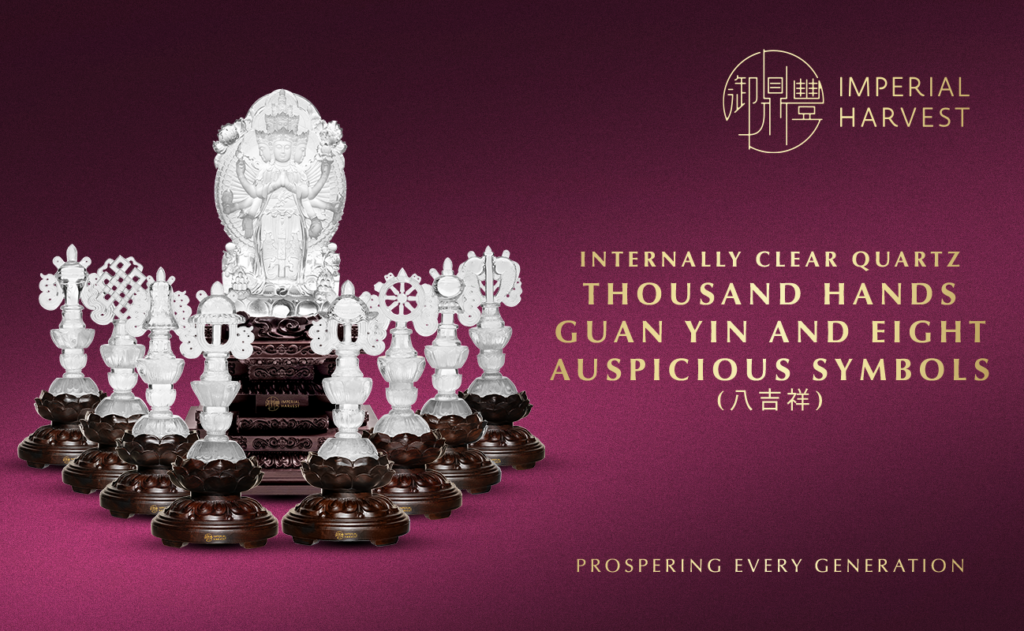
This article examines the two instrument categories that support the ceremonial anchor: the Internally Clear Quartz Thousand Hands Guan Yin, which stands before the anchor as the ritual’s energetic gateway, and the Imperial Harvest Clear Quartz 八吉祥 (Eight Auspicious Symbols), which Grand Master David places across the altar to establish the sacred perimeter.
Book A Free Consultation
Why Internally Clear Quartz

Before examining the forms, it is important to understand the material.
Internally clear quartz is distinguished from common quartz by a specific quality: structural transparency that extends through the body of the crystal, not merely its surface. When light enters internally clear quartz, it does not stop at the surface. It passes through, refracting and multiplying as it travels. The result is a material that appears to glow from within — as though the light originates inside the crystal rather than being reflected from outside.
In Imperial Feng Shui, this optical property corresponds directly to an energetic one. Internally clear quartz does not merely hold energy. It transmits and multiplies it. A single beam of consecrated intention entering the crystal emerges as many — amplified, distributed, and radiated outward. This is why Grand Master David selects internally clear quartz for the Thousand Hands Guan Yin that stands before the anchor. Its function is not to hold the blessing. It is to receive the anchor’s concentrated energy and project it forward, amplified, toward the treasures.
Thousand Hands Guan Yin (千手觀音)

The Thousand Hands Guan Yin is one of the most recognisable manifestations of the Bodhisattva in Chinese Buddhist and Taoist tradition. The form depicts Guan Yin with a thousand arms, each holding a different implement of compassion — a lotus, a sword, a mirror, a vase, a wheel, a jewel — representing her limitless capacity to perceive suffering and respond to it simultaneously in every direction.
On the 出生日, this form carries heightened resonance. The Birth Day is the moment Guan Yin’s compassion first entered the world. The Thousand Hands represent the infinite directions in which that newly born compassion immediately reaches — the first breath becoming a thousand acts of grace. When the ritual is performed on the 出生日, the quartz Thousand Hands figures do not merely distribute an existing blessing. They distribute a blessing that carries the energy of first emergence — compassion in its most potent, most generative form.
In the context of the Grand Blessing Ritual, the Thousand Hands Guan Yin figures serve as the blessing’s distribution system. Where the central agarwood Guan Yin on the anchor is the source — the point where celestial blessing enters the ritual space — the quartz Thousand Hands Guan Yin figures are the channels through which that blessing reaches every corner of the altar.
Each hand symbolically reaches a different aspect of the recipient’s life: career, wealth, health, relationships, wisdom, protection, intuition, family harmony. The Thousand Hands ensure that the consecration’s blessing is not narrow. It is comprehensive. A treasure consecrated in this ritual does not receive a single-purpose blessing. It receives a blessing that has been distributed across the full spectrum of human well-being by Guan Yin’s thousand arms.
Her position directly in front of the ceremonial anchor is the key to understanding her function. The anchor, elevated behind her, is the source — the point where celestial blessing enters the ritual space. The Thousand Hands Guan Yin stands between the source and the treasures that will receive the blessing. She is the gateway. Every beam of consecrated energy that passes from the anchor toward the treasures must pass through her crystal form first — and in doing so, it is multiplied by her thousand hands, each directing a portion of the blessing toward a different dimension of the recipient’s life.
Book A Free Consultation
八吉祥 — The Eight Treasures Ceremonial Artefacts

Placed across the altar by Grand Master David personally, the Imperial Harvest Clear Quartz 八吉祥 establish the ritual’s sacred perimeter. But to call them merely a perimeter understates their significance.
The Eight Treasures trace their origin to the most auspicious moment in Buddhist cosmology: the instant following Shakyamuni Buddha’s enlightenment, when the gods descended and presented these eight symbols as offerings to the newly awakened one. Each symbol is not an abstraction. It corresponds to a specific aspect of Buddha’s enlightened physical form — his head, his eyes, his neck, his tongue, his throat, his heart, his transcendence, his hands. The 八吉祥 are, in their deepest meaning, the body of enlightenment decomposed into eight attributes that can be invoked, consecrated, and bestowed.
Grand Master David has personally commissioned each artefact in clear quartz, a material venerated in Imperial Feng Shui for its purity, vibrational clarity, and capacity to amplify auspicious energies. Through his consecration process, these artefacts are transformed from symbols into active instruments of blessing.
Here is what each of the Eight Treasures embodies, and what it bestows upon the ritual and its destined recipients:
宝伞 Precious Parasol — Mirroring Buddha’s Head
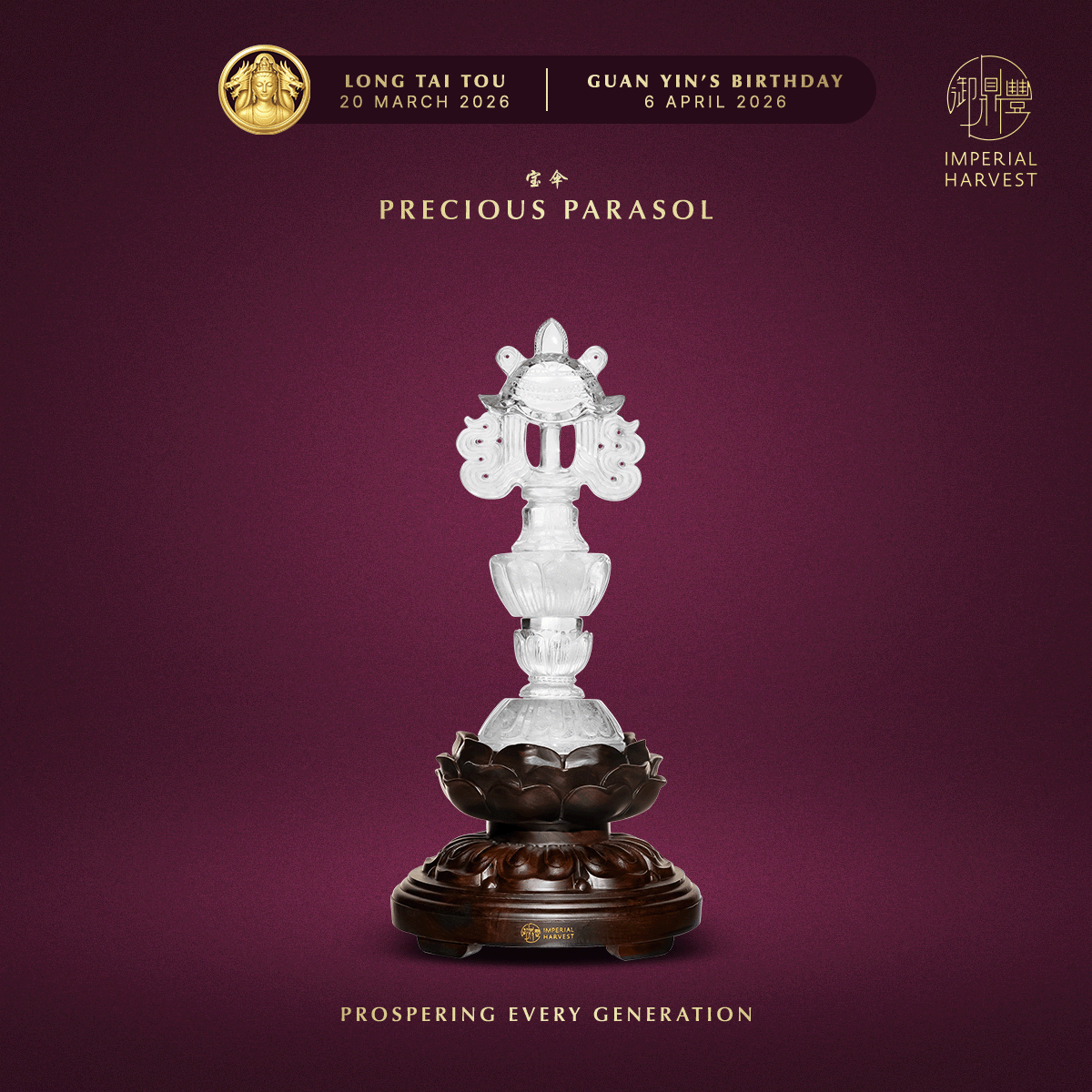
The Precious Parasol is a revered emblem of supreme authority and divine protection. In the original offering, it mirrored the majesty of Buddha’s head — the seat of enlightened consciousness, the highest point of the awakened form.
On the altar, the Precious Parasol establishes a canopy of sovereign protection over the entire ritual space. It shields the consecration from interference, deflects adversity, and ensures that the energies invoked operate under supreme authority. For the treasures consecrated within its field, it enhances the destined owner’s leadership stature, safeguards their wealth and career progression, and empowers clarity in decision-making.
金鱼 Golden Fish — Mirroring Buddha’s Eyes

The Golden Fish bestows exceptional foresight — the ability to see what others cannot. In the original offering, the pair of golden fish mirrored Buddha’s Eyes: the all-seeing clarity that perceives truth in every direction, unobstructed by illusion.
In Buddhist tradition, the two fish swimming freely represent liberation from the ocean of suffering and the ability to navigate life’s currents without fear. On the altar, the Golden Fish sharpens the ritual’s precision — ensuring that the blessing does not merely land, but lands with the accuracy of enlightened sight. For the destined owner, it enhances intuition, accelerates decision-making, and positions them to identify opportunities and anticipate shifts before they become visible to others.
宝瓶 Treasure Vase — Reflecting Buddha’s Neck (Teachings)

The Treasure Vase is an unlimited reservoir of spiritual and material abundance. In the original offering, it mirrored Buddha’s Neck — the channel through which his teachings flowed from enlightened mind to the world. The neck is the bridge between consciousness and expression, and the Treasure Vase embodies this transmission: inexhaustible wisdom becoming inexhaustible wealth.
On the altar, the Treasure Vase ensures that the ritual’s blessing carries the energy of abundance that does not deplete. For the destined owner, it expands wealth capacity, unlocks lucrative avenues, attracts influential partnerships, and aligns them with lasting financial prosperity.
莲花 Lotus Flower — Embodying Buddha’s Tongue

The Lotus Flower represents the ability to transcend adversity with grace and purity. In the original offering, it embodied Buddha’s Tongue — the organ of speech that transformed truth into teaching, that spoke only what was pure, that turned dharma into language the world could receive.
The lotus grows from muddy water yet blooms immaculate above the surface. This principle — purity emerging from impurity, excellence arising from difficulty — is central to what the Grand Blessing Ritual bestows. For the destined owner, the Lotus Flower strengthens credibility, fosters principled leadership, and establishes an enduring foundation of trust and reputation that transcends circumstance.
海螺 Right-Coiled Conch — Mirroring Buddha’s Three Neck Lines

The Right-Coiled Conch harnesses the power of proclamation — the ability to be heard, to command attention, and to have one’s words carry weight. In the original offering, it mirrored Buddha’s Three Neck Lines, the marks of his voice’s resonance and reach. A white conch that coils to the right is exceedingly rare, and its sound was said to carry the dharma across vast distances, awakening beings from ignorance.
On the altar, the Conch amplifies the ritual’s invocations, ensuring that Grand Master David’s prayers carry the full resonance of celestial authority. For the destined owner, it enhances negotiation power, strengthens market visibility, ensures recognition, and forges strategic alliances with influential networks.
吉祥结 Endless Knot — Reflecting Buddha’s Heart

The Endless Knot embodies the seamless interconnection of all phenomena — wisdom and compassion, cause and effect, effort and outcome, woven into a single unbroken pattern. In the original offering, it reflected Buddha’s Heart: the seat of compassion, the centre from which all enlightened action radiates.
This is the most profound of the eight symbols, because it represents the principle that nothing exists in isolation. Every blessing connects to every other. Every quadrant of the Four Quadrants of Destiny influences the others. For the destined owner, the Endless Knot strengthens the networks and partnerships that drive exponential growth, enhances collaboration, and ensures that success is deeply rooted and self-sustaining — not a spike, but a compounding pattern.
胜利幢 Victory Banner — Representing Buddha’s Supreme Enlightenment
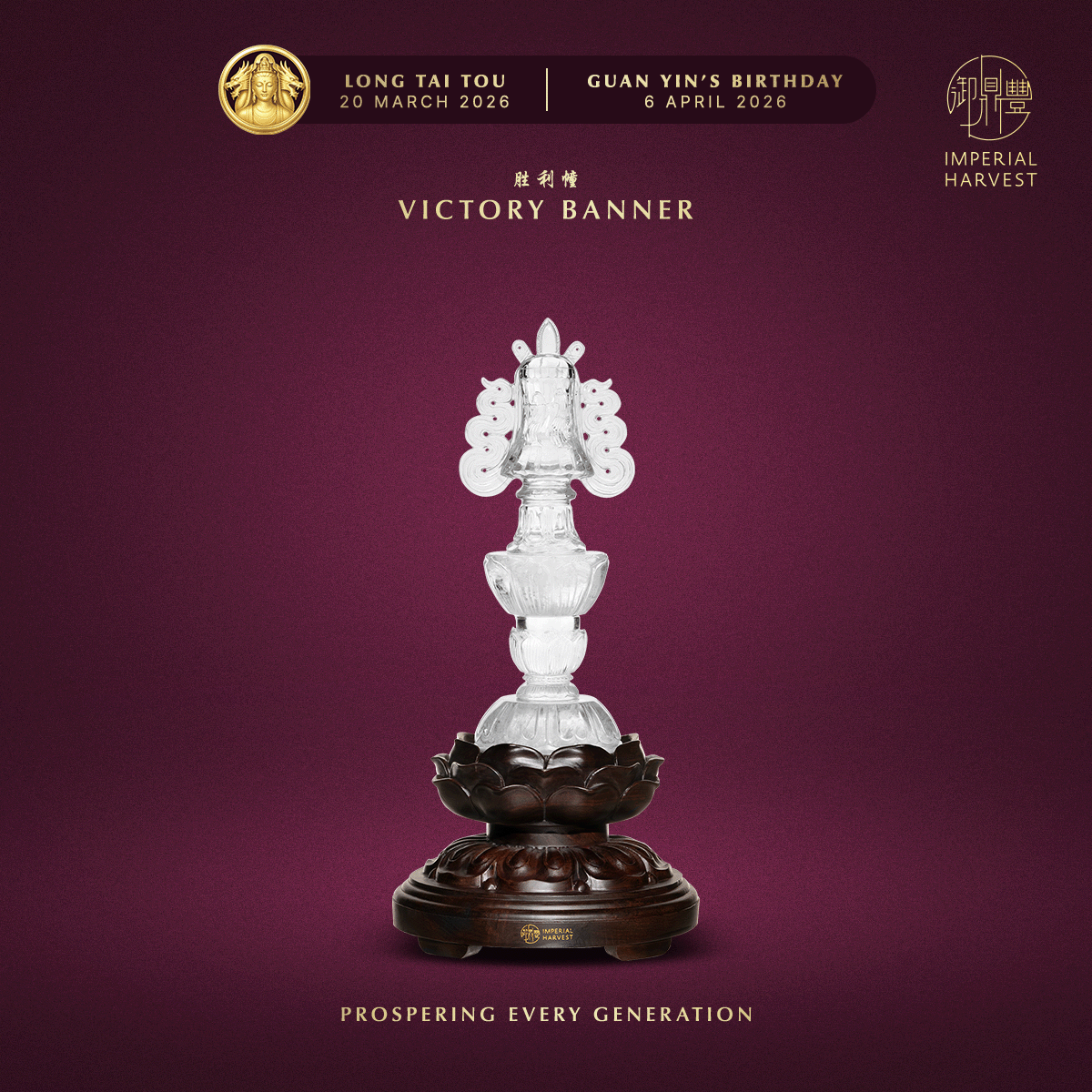
The Victory Banner embodies triumph over all obstacles. In the original offering, it represented the supreme moment itself — Buddha’s victory over the four maras (desire, affliction, death, and the aggregates of self) that constitute the deepest obstacles to liberation.
On the altar, the Victory Banner ensures that the consecration carries the energy of overcoming. Whatever obstacles stand between the destined owner and their alignment — whether structural, relational, or competitive — the Victory Banner’s energy clears the path. It eliminates barriers, secures long-term leadership in the destined owner’s domain, and instils the presence and mindset of one who has already triumphed.
金轮 Dharma Wheel — Reflecting Buddha’s Hands

The Dharma Wheel represents the turning of celestial law and the continuous motion of wisdom in action. In the original offering, it reflected Buddha’s Hands — the instruments through which enlightened intention was enacted in the world. Its eight spokes correspond to the Noble Eightfold Path, and its circular form represents the completeness of enlightened teaching.
On the altar, the Dharma Wheel governs the ritual’s energetic motion — ensuring that the consecration is not static but dynamic, continuously turning, continuously activating. For the destined owner, it unlocks visionary leadership, enhances decision-making with clarity and foresight, and guides them toward sustained influence and generational success.
Book A Free Consultation
The Eight Treasures as a Complete Field

When the eight artefacts are read together, they reconstitute the enlightened form of Buddha on the altar itself. Head, eyes, neck, tongue, throat, heart, transcendence, hands — each aspect present, each radiating its specific blessing. The altar does not merely invoke Buddha’s teaching. It invokes his presence — decomposed into eight aspects, each rendered in clear quartz, each amplifying and radiating its attribute across the ritual space.


This is what the destined owner’s treasure passes through during consecration. Not a generic blessing. A field that contains the full spectrum of enlightened attributes — protection, foresight, abundance, purity, influence, interconnection, triumph, and wisdom in action — all simultaneously active, all directed toward the treasure that will carry these blessings to its owner.
The Complete Ritual Field
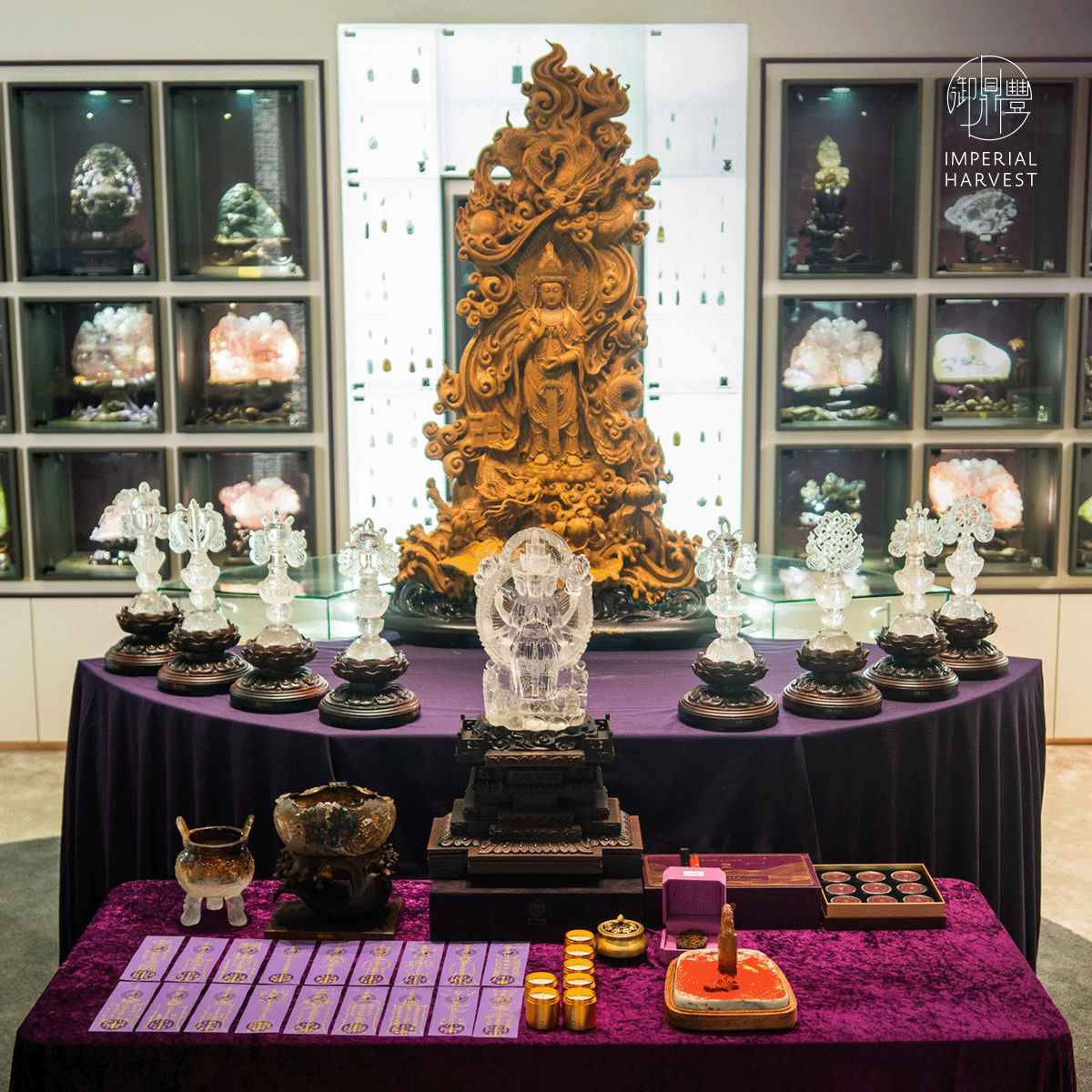
When the central anchor, the Thousand Hands Guan Yin, and the Eight Treasures are read together, the altar’s energetic architecture becomes clear:
The anchor receives and concentrates the celestial blessing from its elevated position. The Internally Clear Quartz Thousand Hands Guan Yin, standing before the anchor, receives that concentrated energy and projects it forward — amplified through her thousand hands into every dimension of the recipient’s life. The Imperial Harvest Clear Quartz 八吉祥, placed across the altar by Grand Master David, reconstitute the enlightened form of Buddha himself — eight aspects of his awakened presence, each protecting, sanctifying, and blessing the ritual space with its specific attribute.
This is the field within which your Imperial Harvest treasure is blessed. Not a single candle and a prayer. A complete celestial architecture in which the body of enlightenment is present, the Bodhisattva of Compassion stands as gateway, and the combined energies of Longtaitou and Guan Yin’s 出生日 flow through every instrument toward the treasure that will carry their blessings to you.
This is the field within which your Imperial Harvest treasure is blessed. Not a single candle and a prayer. A complete celestial architecture, built by a master practitioner, operating at the highest amplitude the calendar permits.