Estimated reading time: 9 minutes
The Real Problem Is Not That Wealth Is Absent. It Is That Only One Channel Is Open.
Most professionals who come to Imperial Harvest are not struggling. They are capable. They are disciplined. They are doing the work. And they have been doing it for years.
What brings them to the consultation room is something more specific. Their income holds steady but never breaks through. A business deal closes but the windfall they expected from it evaporates in unexpected costs. An investment portfolio appreciates on paper while the liquidity they need never arrives. A promotion comes but the recognition that should accompany it is quietly assigned elsewhere.
The common diagnosis is that they need to work harder, pivot, or wait. The correct diagnosis is structural. In the imperial framework of Chinese metaphysics, wealth does not arrive through a single gate. It arrives through five — and most people are only aligned with one.
The question is not whether wealth exists in your chart. It is whether every one of the five directions from which wealth arrives has been opened, authorised, and activated in your favour.
Wealth Flowing In from Every Source — 财源广进
The governing framework of this blessing ritual is Wealth Flowing In from Every Source (财源广进 — cái yuán guǎng jìn). It is among the most enduring wealth idioms in the Chinese canon — inscribed on countless red banners, spoken in every Lunar New Year greeting, and treated as the most fortuitous aspiration a Chinese household can hold. The precision of its two characters is what makes it irreplaceable here. 财源 is the Chinese term for the sources of wealth — the celestial origins from which wealth flows into a life. 广进 is the expression for broad, simultaneous arrival from every direction.
财源广进 therefore describes a state in which wealth does not trickle in from a single origin but flows in from every legitimate source at once — direct income from one source, indirect gains from another, sovereign authority from a third, preservation from a fourth, and compounding transactional profit from the fifth. No gate remains closed. No source remains silent.
This is precisely what the Five Wealth Gods configuration was designed to manifest. Each of the five deities is a 财源 — a sovereign source of wealth — assigned to one of the five directions: East, South, Centre, West, North. Each commands the origin from which wealth flows from that direction. When all five are invoked together, they pay tribute to the same outcome: 财源广进. Five sources converging into a single simultaneous arrival. This is not metaphor. It is the literal theological mechanism of the Five Wealth Gods architecture.
The Season of Nourishment — Grain Rain and the Five Wealth Gods
There is a reason the Five Wealth Gods Blessing Ritual carries particular potency in the days surrounding the sixth solar term of the Chinese year. In the imperial agricultural calendar, this season is 谷雨 (gǔ yǔ — Grain Rain), falling in late April — the final solar term of spring, and the moment at which the rains arrive to nourish the five grains (五谷 — wǔ gǔ) that will mature into the year’s harvest.
The Chinese mind did not treat the agricultural calendar and the wealth calendar as separate systems. They were the same system, expressed through different domains. 谷雨 is the moment at which what has been sown receives what it needs to mature. Seeds planted in earlier seasons — through preparation, effort, and the disciplined work of cultivation — would remain dormant without the nourishment of the Grain Rain. The seeds are the potential. The rain is the activation. And without the rain, no amount of careful sowing produces a harvest.
This is the precise theological parallel to the Five Wealth Gods. A Bazi chart sown with capability, ambition, and disciplined effort will not, by itself, produce proportionate wealth. What converts the sown potential into the realised harvest is the nourishment that arrives from every one of the five sources. 五谷丰盛 (wǔ gǔ fēng shèng) — the five grains flourishing into abundance — is the agricultural expression. 财源广进 — wealth flowing in from every source — is its wealth-domain counterpart. Both describe the same structural event: five sovereign channels of nourishment converging simultaneously on what had been planted, transforming latent potential into actual abundance.
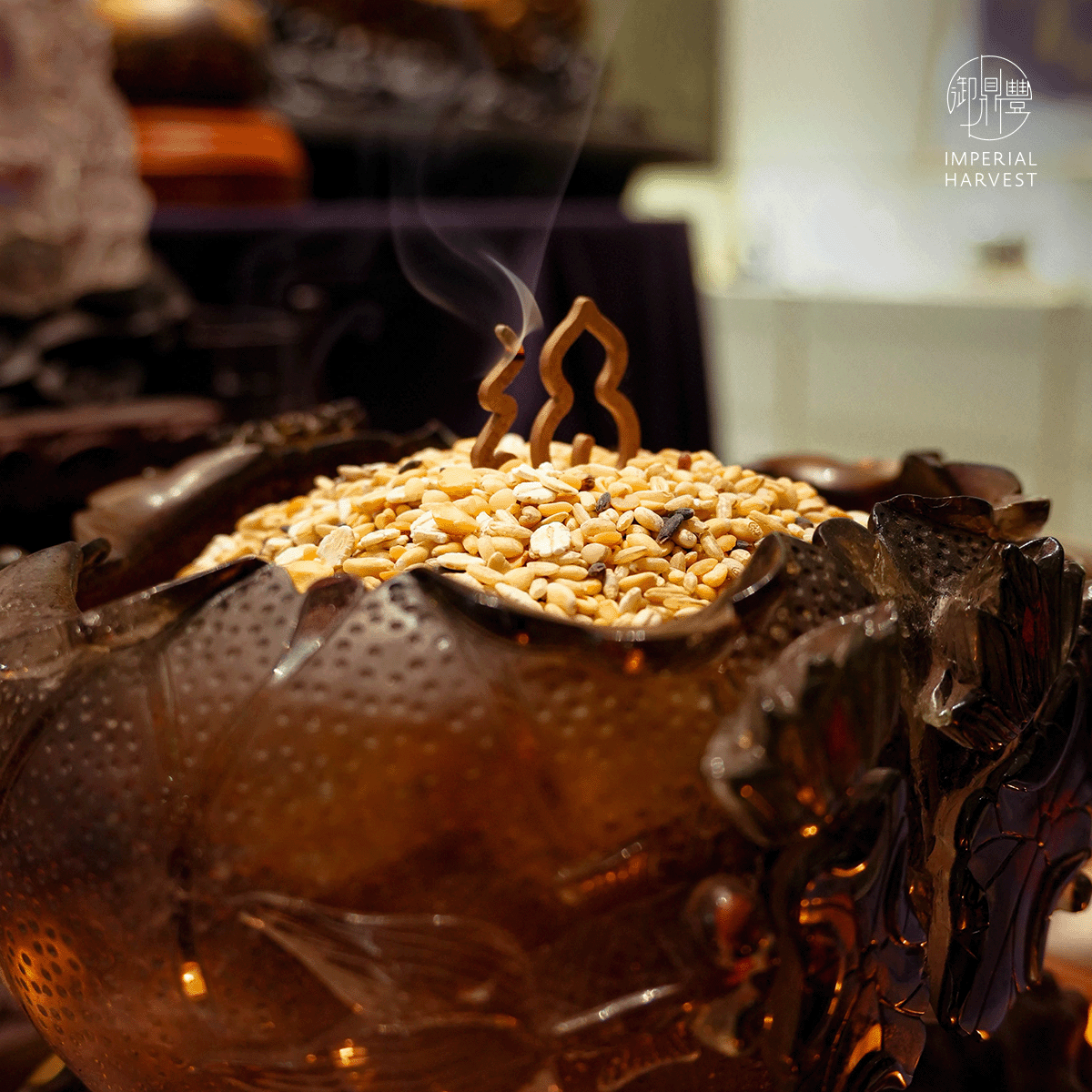
The five grains of imperial Chinese tradition — 稻 (rice), 黍 (millet), 稷 (sorghum), 麦 (wheat), 菽 (legumes) — were not cultivated in isolation. They were planted together so that the failure of one would not mean the failure of the harvest. The imperial wisdom was structural: agricultural security required plurality, not singular dependence. The same wisdom governs the wealth architecture. Wealth that depends on a single source is wealth perpetually at risk. Wealth that flows from five sources is wealth that has achieved the imperial standard of security — the abundance that, because it arises from multiple channels, cannot be extinguished by the failure of one.
谷雨 nourishes the five grains into 五谷丰盛. The Five Wealth Gods nourish the five sources into 财源广进. One tradition. Two expressions. The same imperial logic of abundance secured through plurality.
The season of Grain Rain leads directly into one of the most significant dates in the wealth god calendar: the birthday of Zhao Gong Ming (赵公明圣诞), observed on the fifteenth day of the third lunar month. In 2026, this falls on 1 May — the transition from the nourishment of Grain Rain into the active governance of the central wealth sovereign. The symbolism is exact. Grain Rain concludes the season in which potential is nourished. Zhao Gong Ming’s birthday inaugurates the season in which that nourished potential is commanded into realised wealth. For clients whose Imperial Harvest treasures are consecrated within this window, the ritual carries the full seasonal authority of both moments — the nourishment and the command, the rain and the marshal, 五谷丰盛 and 财源广进 drawn into a single consecration.
Book A Free ConsultationThe Imperial Lineage — How the Five Wealth Gods Were Bound Together
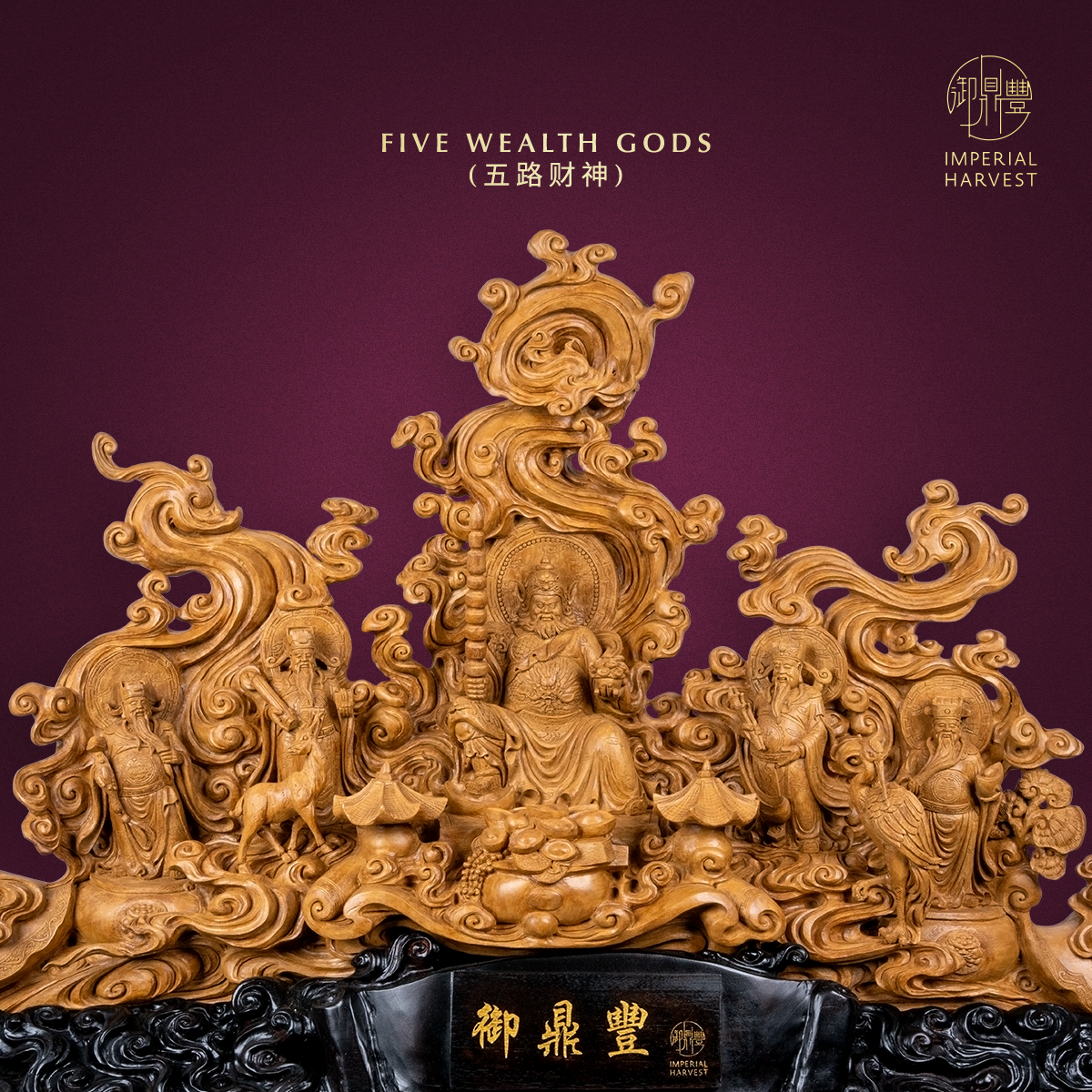
The worship of the Five Wealth Gods (五路财神) did not begin with wealth. Its earliest form — recorded in imperial ritual texts as the 五路神, the Five Path Gods — placed these deities among the 五祀, the five sovereign sacrifices of ancestral tradition, where they were honoured as 行神, guardians of travel. Merchants in an earlier China did not distinguish between the journey and the goods carried along it. To travel safely was to trade profitably. As commerce deepened across the dynasties, the same five directional gods who once blessed a merchant’s passage came to bless his ledger. The pathway god became the wealth god — and the five directions became the five channels of prosperity itself.
The theological crystallisation of this tradition arrived in the Ming dynasty novel Fengshen Yanyi (封神演义) — the Investiture of the Gods. There, the Five Wealth Gods received their sovereign narrative: the war, the defeats, the deaths, and the investiture that bound them together as a permanent heavenly office. What emerges from that narrative is one of the most remarkable reconciliations in Chinese mythological tradition. The five deities who now share eternal stewardship of the wealth domain were, in life, bound together not by alliance but by conflict.
Zhao Gong Ming (赵公明) — The Marshal Who Earned His Throne Through Battle
Before the Ming dynasty established him as the sovereign of wealth, Zhao Gong Ming (赵公明) appeared first in the Eastern Jin text Soushen Ji (搜神记) — the fourth-century Records of the Search for Spirits — in a very different role. There he was a plague deity, an officer of the celestial bureau who gathered souls at their appointed hour. It was only with Fengshen Yanyi, more than a thousand years later, that he was formally invested as the central wealth god. The transformation from plague officer to wealth sovereign is not a contradiction. Both roles belong to the same theological architecture: the deity who commands the ledger on which lives are recorded is the same deity who commands the ledger on which fortunes are written. Authority over entries and authority over abundance are, in the imperial framework, the same sovereign function.
The Fengshen Yanyi narrative gave him the biography by which he is now known. Born Zhao Lang (赵朗), styled Gong Ming, he was a second-generation disciple of the Jie sect (截教) under the Supreme Patriarch Tong Tian (通天教主), cultivating at the Luofu Cave of Mount Emei (峨眉山罗浮洞) until he attained the rank of Great Luo Immortal (大罗神仙) — the highest celestial grade a mortal can reach. His three younger sisters — Yun Xiao, Bi Xiao, and Qiong Xiao (云霄、碧霄、琼霄) — held court on the Three Immortals Isle. His character was summarised in eight words: 义薄云天,性如烈火 — righteousness reaching to the heavens, temperament like raging fire.
His black tiger is itself a theological artefact. Originally a savage beast of Mount Zhongnan (终南山), subdued by Zhao Gong Ming during his cultivation, it became his sovereign mount — and in folk tradition a 镇宅神兽, a guardian beast whose presence simultaneously suppresses evil and summons wealth. The golden whip in his hand, the twenty-four Sea-Stilling Pearls (定海神珠) at his side, the Dragon-Binding Cord (缚龙索) coiled at his belt, and the Golden Dragon-Scissors (金蛟剪) later borrowed from his three sisters — this was the complete arsenal of the immortal who answered Grand Tutor Wen Zhong’s summons and descended from Mount Emei to assist the Shang against the armies of the Zhou.
What followed was among the most devastating campaigns in the Investiture narrative. Zhao Gong Ming struck down Jiang Ziya (姜子牙) himself in a single blow, toppled Ne Zha (哪吒) from his wind-fire wheels, captured the immortal Huang Long with his Dragon-Binding Cord, and routed five senior Chan sect immortals in succession — Chi Jing Zi, Guang Cheng Zi, Dao Xing Tian Zun, Yu Ding Zhen Ren, and the Ling Bao Great Dharma Master — using only his Sea-Stilling Pearls. Even the vice-patriarch Ran Deng (燃灯道人), beholding the five-coloured radiance of the pearls, was forced to abandon his deer and flee. Zhao Gong Ming was not simply powerful. He was structurally dominant.
His defeat came not through superior combat but through the workings of a darker order. The wandering immortal Lu Ya (陆压道人) invoked the forbidden Nail-Head Seven-Arrow ritual (钉头七箭书) — raising a platform on Mount Qi, binding a straw effigy inscribed with Zhao Gong Ming’s name, and instructing Jiang Ziya to bow to it three times daily for twenty-one days while a cursed arrow was driven into it at each bow. No martial prowess could counter a curse that operated beyond the plane of combat. Zhao Gong Ming sent his two disciples, Chen Jiu Gong and Yao Shao Si, to intercept the cursed document. Both died in the attempt. On the twenty-first day, struck by arrows that had never touched physical air, Zhao Gong Ming fell in the Shang camp.
Xiao Sheng (萧升) and Cao Bao (曹宝)— The Hermit Brothers of Mount Wuyi
Xiao Sheng (萧升) and Cao Bao (曹宝) were wandering immortals of the Twin Immortal Ridge (二仙岭) on Mount Wuyi — sworn brothers whose lives were a study in Taoist quietude. They spent their days seated across a chess board, debating the Way, laughing at the ambitions of other cultivators, and refusing to involve themselves in the affairs of the mortal or immortal worlds. Their power did not rest in combat. It rested in a single celestial implement they shared between them: the Falling Treasure Golden Coin (落宝金钱) — a winged primordial treasure in the shape of a square-holed bronze coin, capable of capturing any artefact of rank below the highest primordial tier. Its singular limitation was that it had no effect on weapons.
When Zhao Gong Ming pursued Ran Deng to the foot of their mountain, the two brothers broke their long seclusion out of a sense of righteousness, unwilling to see the elder immortal cornered. Xiao Sheng released the Falling Treasure Golden Coin and in two successive motions drew away the Dragon-Binding Cord and the Sea-Stilling Pearls. Enraged, Zhao Gong Ming cast his golden whip — and because the whip was a weapon and not a talisman, the Falling Treasure Coin could not intercept it. Xiao Sheng was struck down on the spot. Cao Bao, stricken with grief at his brother’s death, abandoned the hermit life, joined the Chan sect’s forces, and marched with them to the Zhou camp. He fought with distinction until he was assigned to break the Red Water Formation (红水阵) — a lethal formation set by the Jie sect disciple Wang Bian (王变) — and was killed within it. The brothers who had once played chess in eternal quietude died within months of each other, both for the same cause.
Chen Jiu Gong (陈九公) and Yao Shao Si (姚少司) — The Disciples Who Died for Their Master
Chen Jiu Gong (陈九公) and Yao Shao Si (姚少司) were Zhao Gong Ming’s direct disciples — 同门师兄弟, brothers of the same cultivation lineage, trained together at the Luofu Cave on Mount Emei. Chen Jiu Gong was known for his twin swords, with which he fought in his master’s campaigns and proved himself among Zhao Gong Ming’s most capable disciples. When Grand Tutor Wen Zhong commanded the two of them to intercept the cursed Nail-Head Seven-Arrow document and break the ritual that was consuming their master, they accepted the mission without hesitation. But neither had the strength to breach the Zhou camp. Chen Jiu Gong fell to the spear of Yang Jian (杨戬). Yao Shao Si fell to the blade of Ne Zha (哪吒). Master and disciples — three figures of the same school — died one after another in the same campaign, each for the other.
The Investiture — Former Enemies Bound as Eternal Allies
At the close of the war, when Jiang Ziya ascended the Investiture Platform (封神台) under the sovereign mandate of the Supreme Primordial Heavenly Worthy, five figures were placed together as the Five Wealth Gods — the sovereign administration of all wealth under Heaven. Zhao Gong Ming was elevated to a title whose weight exceeded anything his mortal cultivation could have attained: Golden Dragon Ru Yi Orthodox Unity Dragon Tiger Mystic Altar True Lord (金龙如意正一龙虎玄坛真君之神) — commander of four subordinate wealth deities, sovereign of fortune and misfortune, the receiver of auspicious blessings and the pursuer of fugitives. Beneath him were placed the four figures whose lives had crossed his in violence: Xiao Sheng as Treasure-Summoning Celestial Worthy (招宝天尊), Cao Bao as Treasure-Receiving Celestial Worthy (纳珍天尊), Chen Jiu Gong as Wealth-Attracting Emissary (招财使者), and Yao Shao Si as Market-Profit Immortal Official (利市仙官).
The meaning of this investiture is theological, not political. Xiao Sheng — who stripped Zhao Gong Ming of his two greatest treasures. Cao Bao — who took up arms against him. Chen Jiu Gong and Yao Shao Si — who died in a failed rescue mission before they could reach him. Former enemies. Fallen disciples. All unified under a single celestial mandate. The doctrinal message is one of the most profound in Chinese spiritual tradition: on the path of wealth, grudges must be set aside, and only cooperation produces mutual fortune. Wealth itself is not the province of any one force. It requires the coordinated collaboration of every channel — commerce, preservation, relationship, authority, and industry — functioning as a single reconciled whole.
Wealth, in the imperial framework, does not arrive from a single source. It arrives from five. And only where all five sources stand in reconciled cooperation does 财源广进 become possible.
Book A Free ConsultationThe Five Wealth Gods and the Five Pathways of Wealth
Each of the five wealth gods presides over one specific, non-overlapping pathway through which wealth enters a life. These pathways do not substitute for one another. Commerce without preservation dissipates. Authority without relationship isolates. Industry without opportunity stagnates. This is why the imperial system insists on all five, and why Imperial Harvest’s consecration protocol invokes each deity individually — each with their own authority, their own pathway, and their own function within the whole. A client whose Bazi chart reveals a suppressed capacity for indirect wealth requires the activation of Cao Bao’s western pathway. A client whose professional income is structurally capped requires the activation of Yao Shao Si’s northern pathway. The pathways are distinct because the sources of wealth are distinct — and the consecration must be equally distinct to produce proportionate results.
Centre — Zhao Gong Ming · Marshal of the Mystic Altar (中路武财神赵公明)
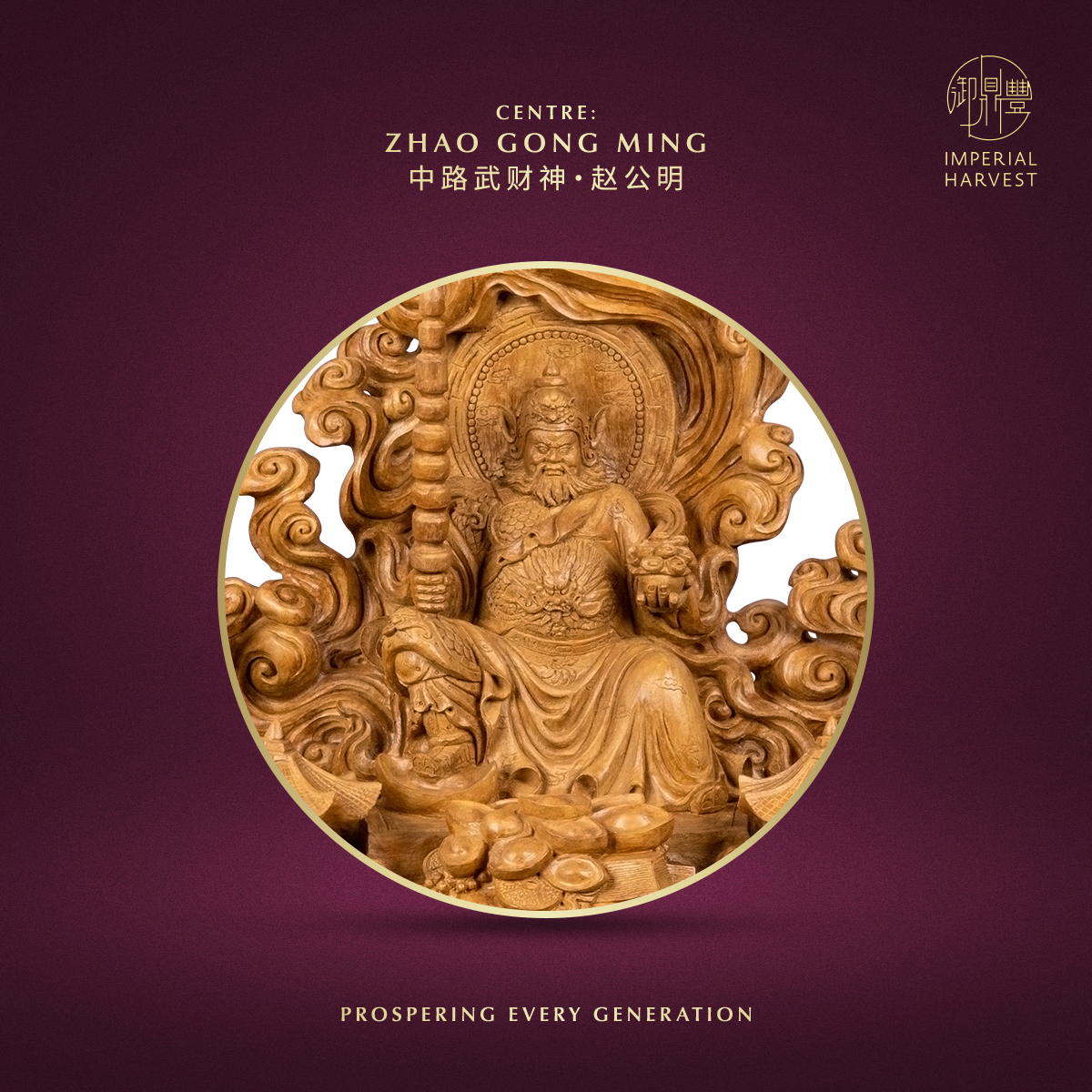
The Centre is the seat of supreme authority. Zhao Gong Ming, as Marshal of the Mystic Altar, presides over wealth derived from direct authority, leadership, and command — the central hub through whom all four other wealth channels are coordinated and activated. He does not govern a single source. He governs the cooperation of all five. For the executive, the founder, the managing principal — those whose financial outcomes depend on whether their authority converts into proportionate reward — this is the pathway that determines whether the sovereignty they hold in their organisation translates into the sovereignty they hold in their wealth.
East — Xiao Sheng · Treasure-Summoning Celestial Worthy (东路财神招宝天尊萧升)
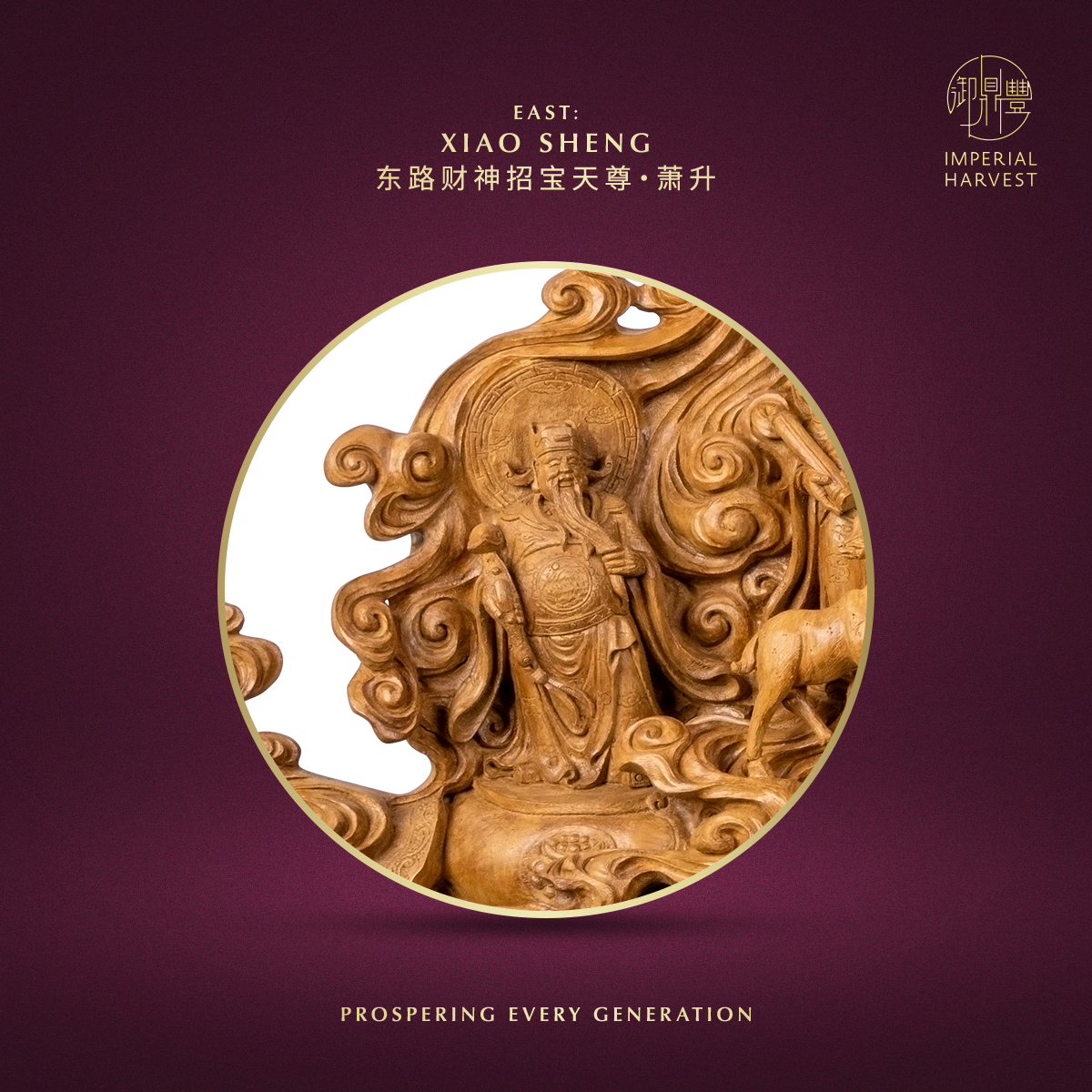
The East is the direction of commerce — of active trade, transactions, and enterprise. Xiao Sheng, whose Falling Treasure Golden Coin once drew celestial treasures from the air itself, presides over the active attraction of wealth through commercial activity. Where his coin once summoned talismans, his sovereignty now summons revenue. For the business owner, the salesperson, the entrepreneur — those whose prosperity depends on the active attraction of commerce through the front door — this is the pathway through which trade, transactions, and deal-making convert into measurable wealth.
South — Chen Jiu Gong · Wealth-Attracting Envoy (南路财神招财使者陈九公)
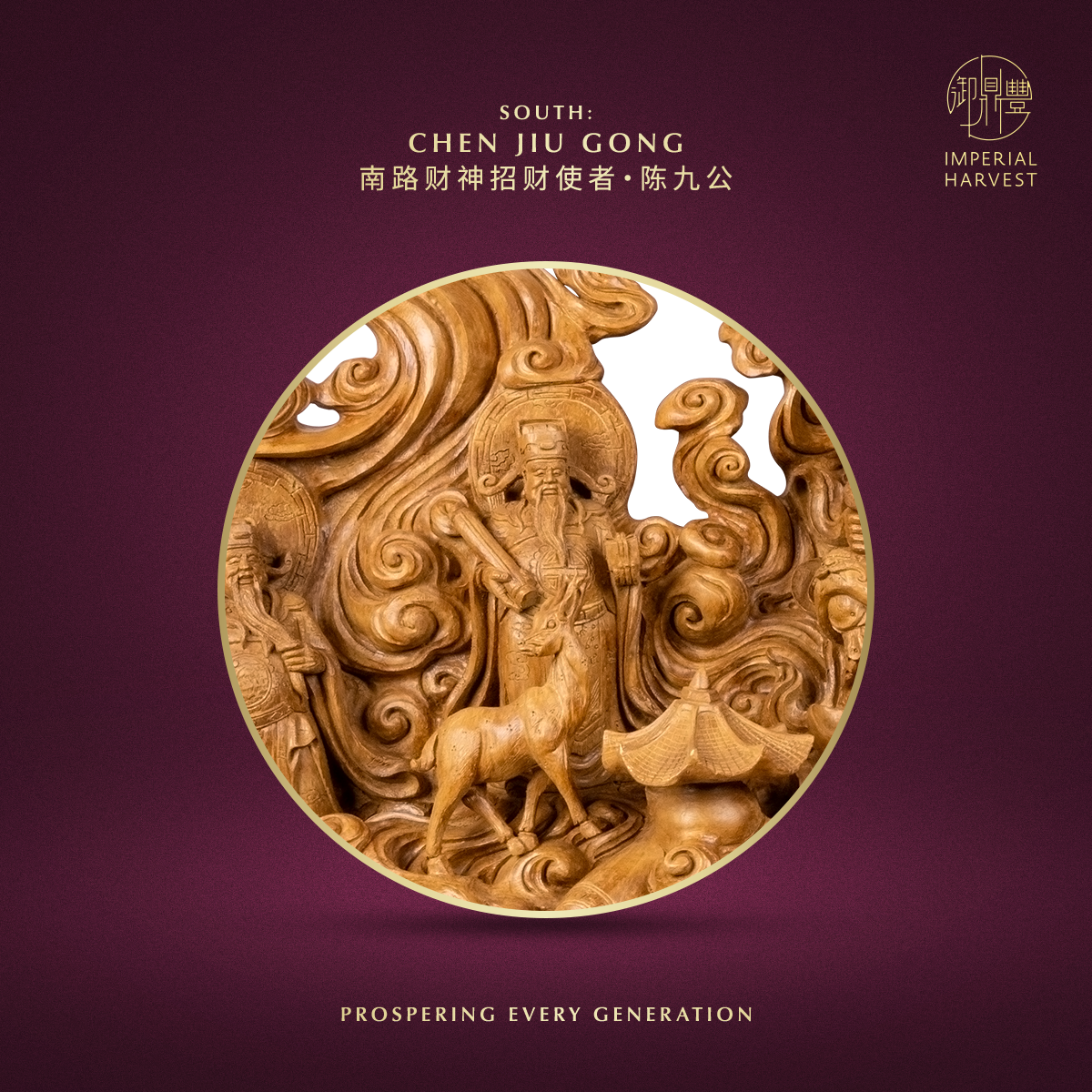
The South is the direction of relationship — of networks, social capital, and the financial yield of human connection. Chen Jiu Gong, the loyal disciple who died for his master’s rescue, presides over the relational dimension of wealth: referrals, introductions, partnerships, and the conversion of trust into revenue. In Chinese, his office is formulated as 招揽四方财运 — to draw wealth fortune from all four directions, letting the sources converge through the bonds of relationship. For the realtor, the financial advisor, the consultant, the professional whose livelihood depends on the strength of their network — this is the pathway that determines whether relationships convert into revenue, and whether reputation opens the doors that capability alone cannot.
West — Cao Bao · Treasure-Receiving Celestial Worthy (西路财神纳珍天尊曹宝)
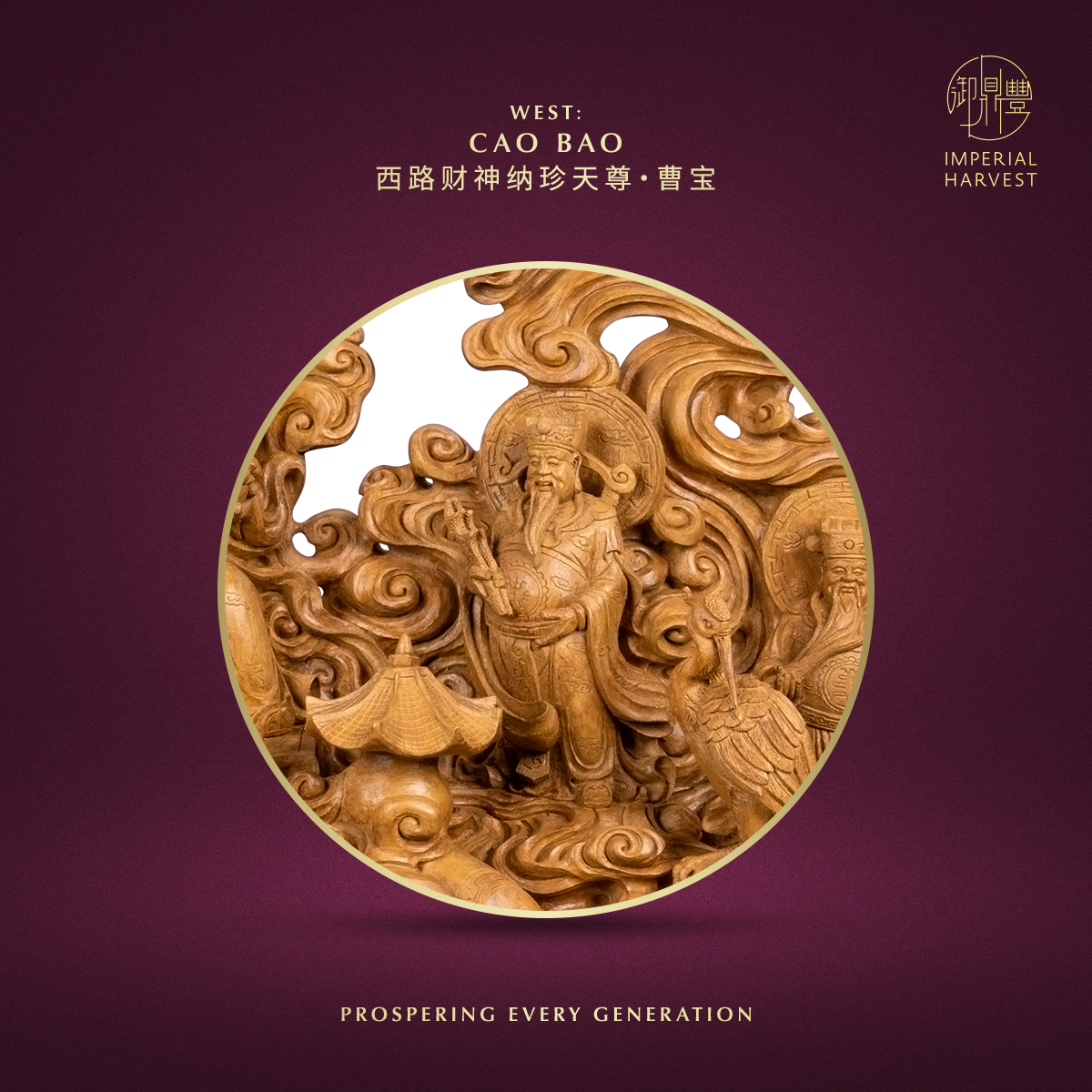
The West is the direction of indirect wealth — of windfalls, unexpected inflows, and the appreciation of assets the owner did not actively pursue. Cao Bao’s sovereign function, 纳珍 — the taking-in and safeguarding of precious things — is a dual mandate: to receive wealth from sources the individual did not directly solicit, and to protect what has entered from leaving. Where Xiao Sheng summons treasures through the front door of commerce, Cao Bao receives and preserves what arrives through the side gate of fortune. For the investor, the asset holder, the beneficiary of capital gains, inheritance, or appreciation on long-held positions — this is the pathway that determines whether indirect wealth flows in, and whether once it has flowed in, it stays.
North — Yao Shao Si · Market-Profit Immortal Official (北路财神利市仙官姚少司)
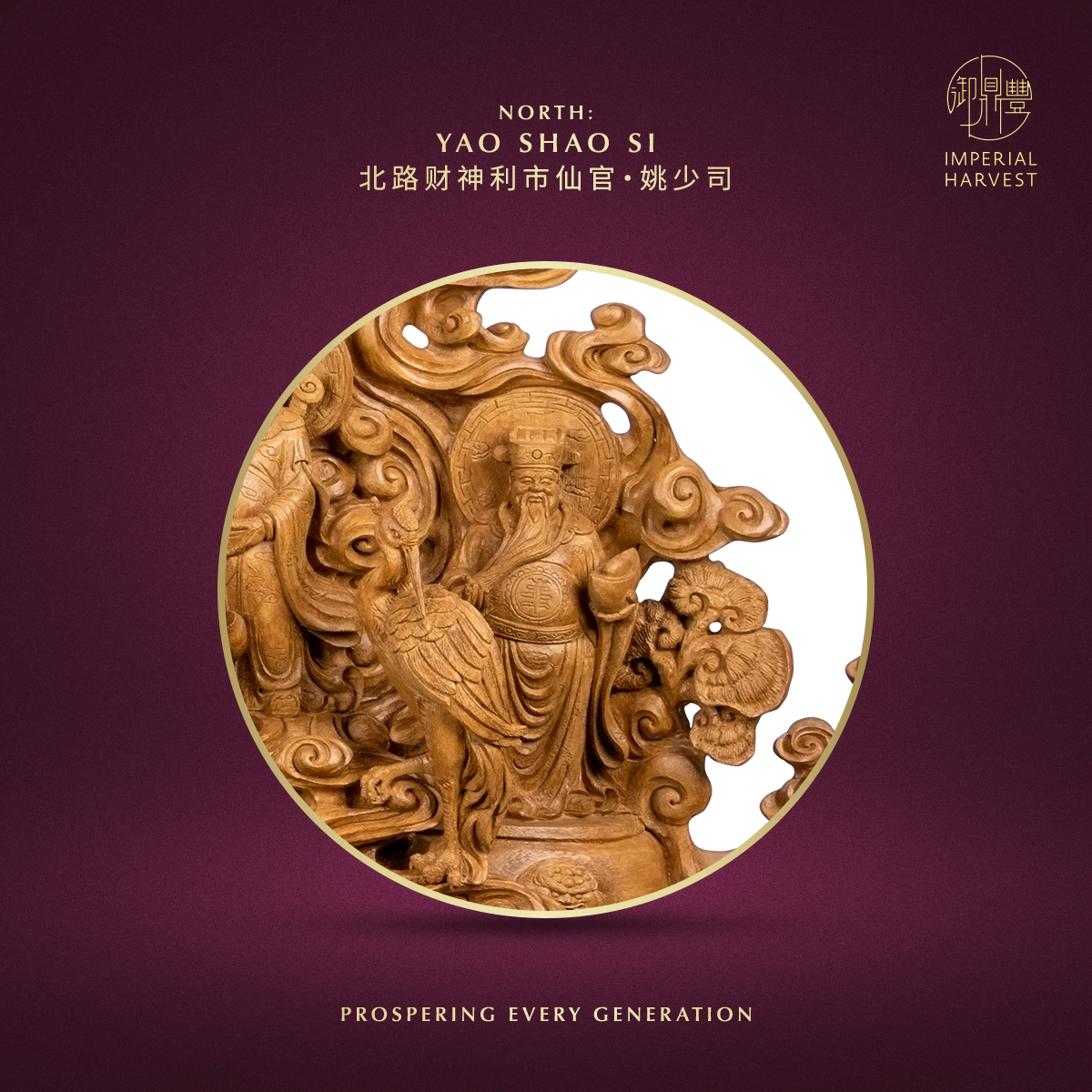
The North is the direction of industry — of sustained labour, disciplined endeavour, and the daily conversion of effort into income. Yao Shao Si presides over 利市 (lì shì), a Chinese term carrying three simultaneous meanings: the profit of commercial transactions, the auspicious fortune of favourable timing, and the celebratory capital of festive occasions including the red packets given at Lunar New Year. Since the Song dynasty, merchants have pasted his image on their doors beside the Wealth-Attracting Child (招财童子), flanked by the couplet 招财童子至 / 利市仙官来 — the Wealth-Attracting Child arrives, the Market-Profit Immortal Official comes — an invocation of daily commercial yield repeated across a thousand years. In later tradition he was often depicted as a literate official holding an abacus or a golden ingot, symbolising the precise, disciplined command of commercial profit. For the salaried professional, the tradesperson, the disciplined earner whose wealth accumulates through consistent daily effort — this is the pathway that ensures each day’s work yields its proportionate reward.
This is the architecture the imperial tradition calls 财源广进. Not five separate blessings placed alongside one another, but five pathways operating in reconciled simultaneity — the structural completeness without which wealth itself cannot stabilise. A single channel, however powerful, fills one pathway and leaves four empty. The Five Wealth Gods Blessing Ritual fills all five at once.
Five pathways. Five sources. Five sovereign emissaries. When all five are invoked together, they pay tribute to the same outcome — what the imperial tradition has always called 财源广进, and what Imperial Harvest’s clients experience as the architectural completion of every channel through which wealth was ever authorised to enter their lives.
Book A Free ConsultationThe Imperial Harvest Blessing Ritual — Three Instruments of the Highest Order
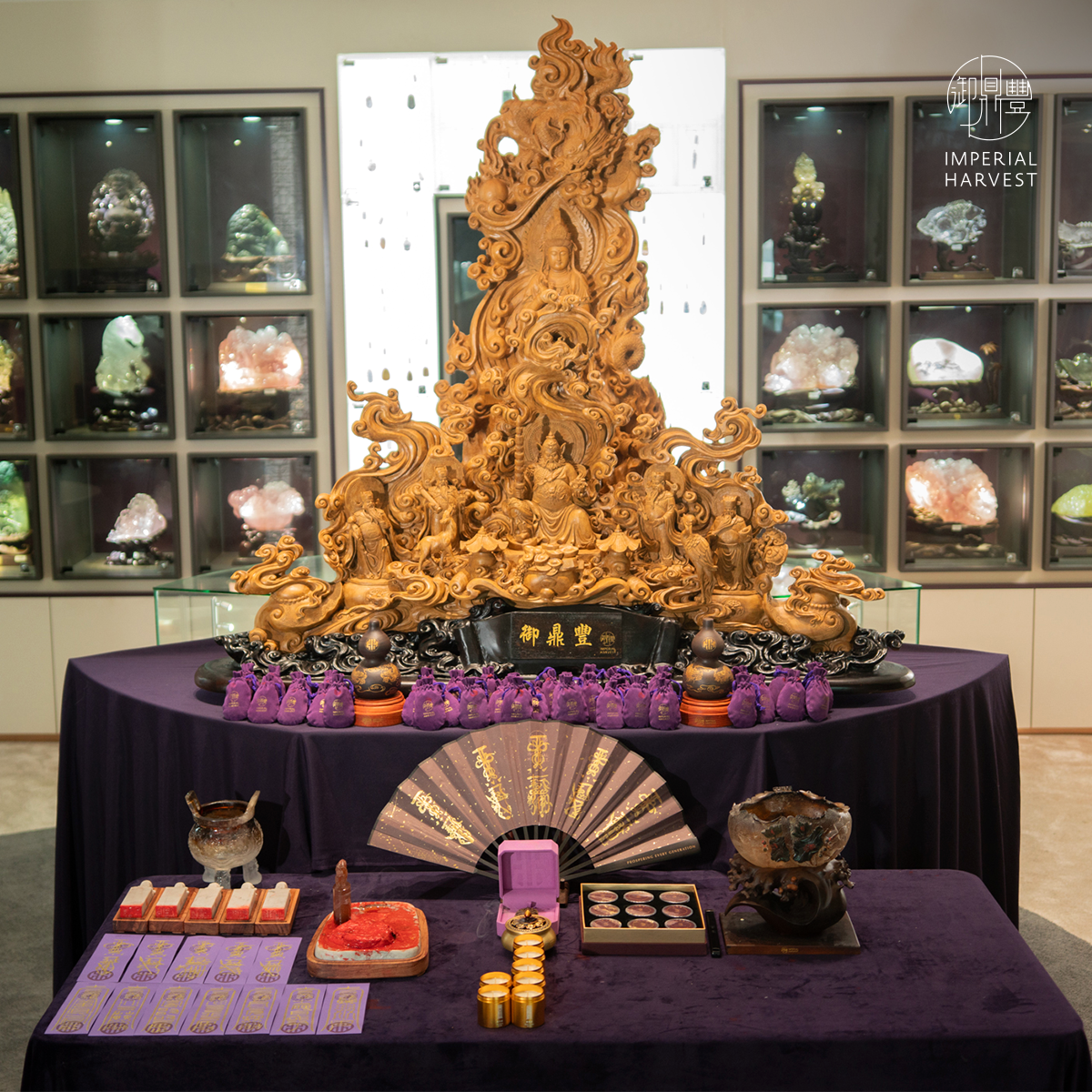
What distinguishes the Imperial Harvest Five Wealth Gods Blessing Ritual from any other consecration performed under this deity configuration is the sovereign authority of the instruments through which Grand Master David Goh conducts it. Three commissioned instruments — each sovereign in its own register, each bearing one dimension of the authority through which the five wealth gods are invoked — sit at the centre of every blessing.
The Ceremonial Anchor — Red Earth Agarwood Five Wealth Gods
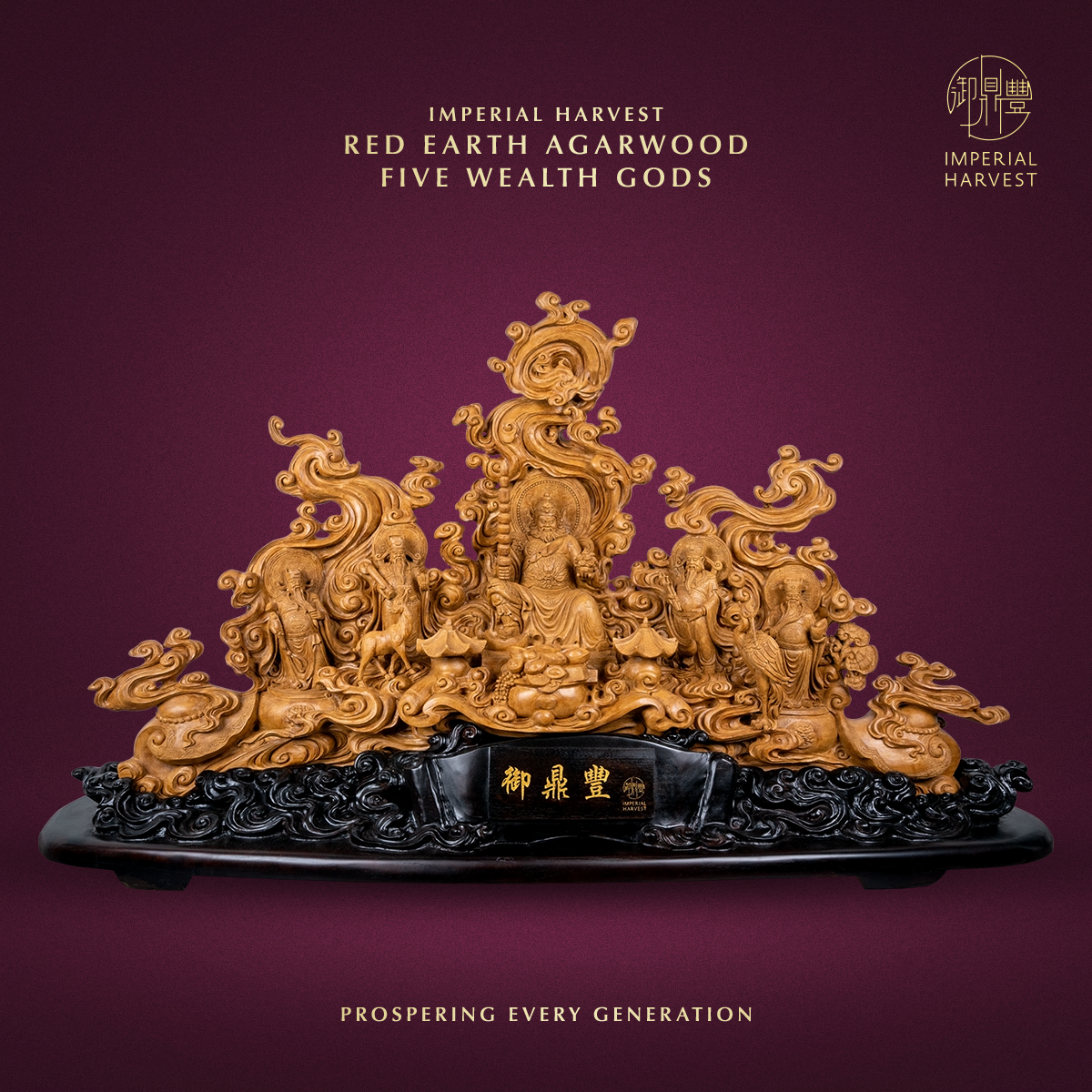
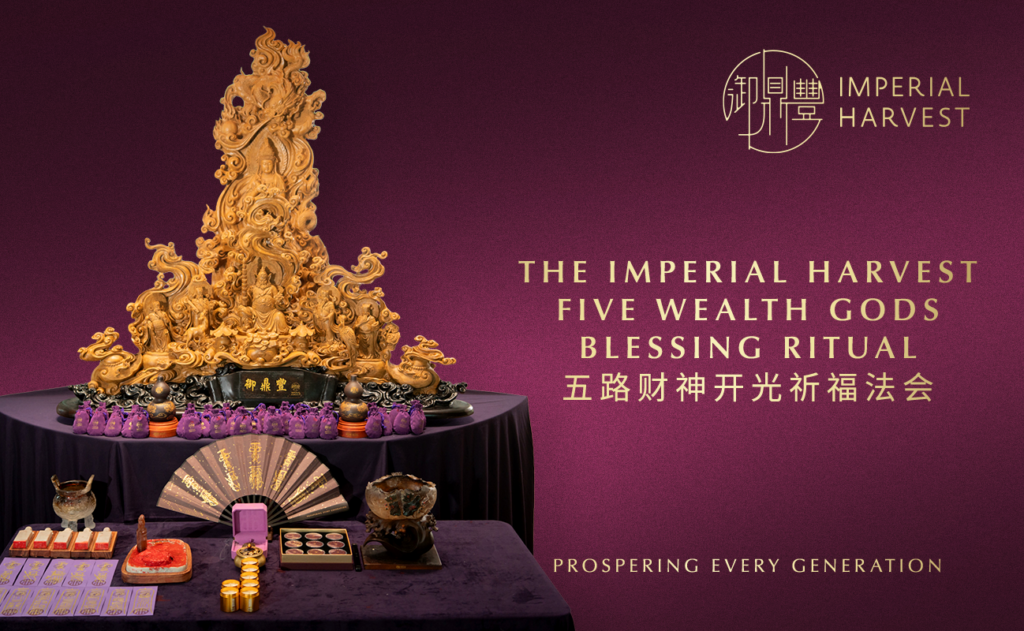
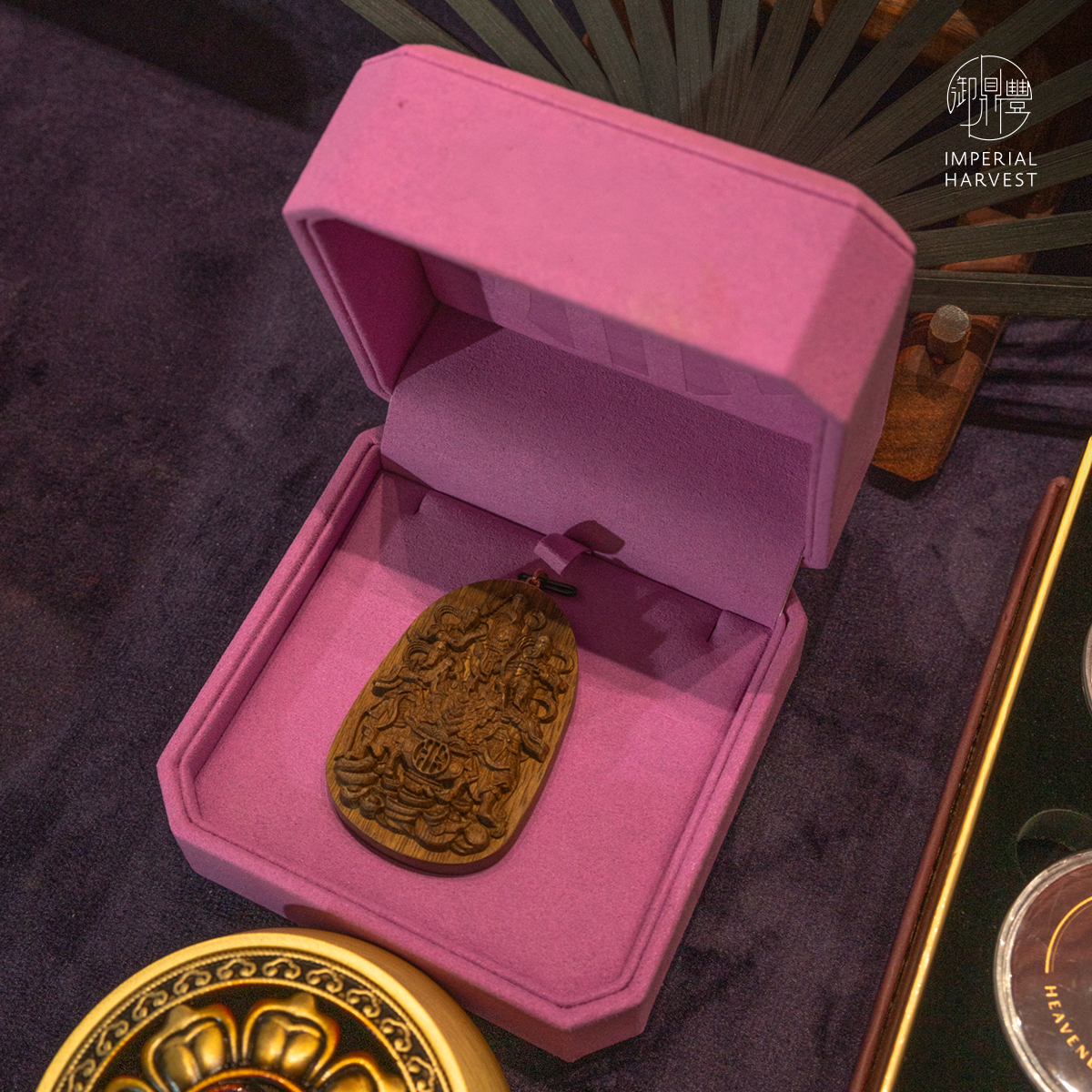
At the physical and spiritual centre of the ritual stands the Imperial Harvest Red Earth Agarwood Five Wealth Gods Ceremonial Anchor — a monumental consecration masterpiece hand-carved from Red Earth Agarwood (红土沉), a sovereign consecration material within Imperial Harvest’s agarwood hierarchy. Red Earth Agarwood is formed when resin-saturated heartwood has been buried in iron-rich earth for centuries of subterranean transformation. The iron in the soil gives the grain its honey-amber warmth. The centuries of pressure give it its sovereign weight. It carries a resin concentration and aromatic authority reserved for the most significant ceremonial instruments in our consecration suite.
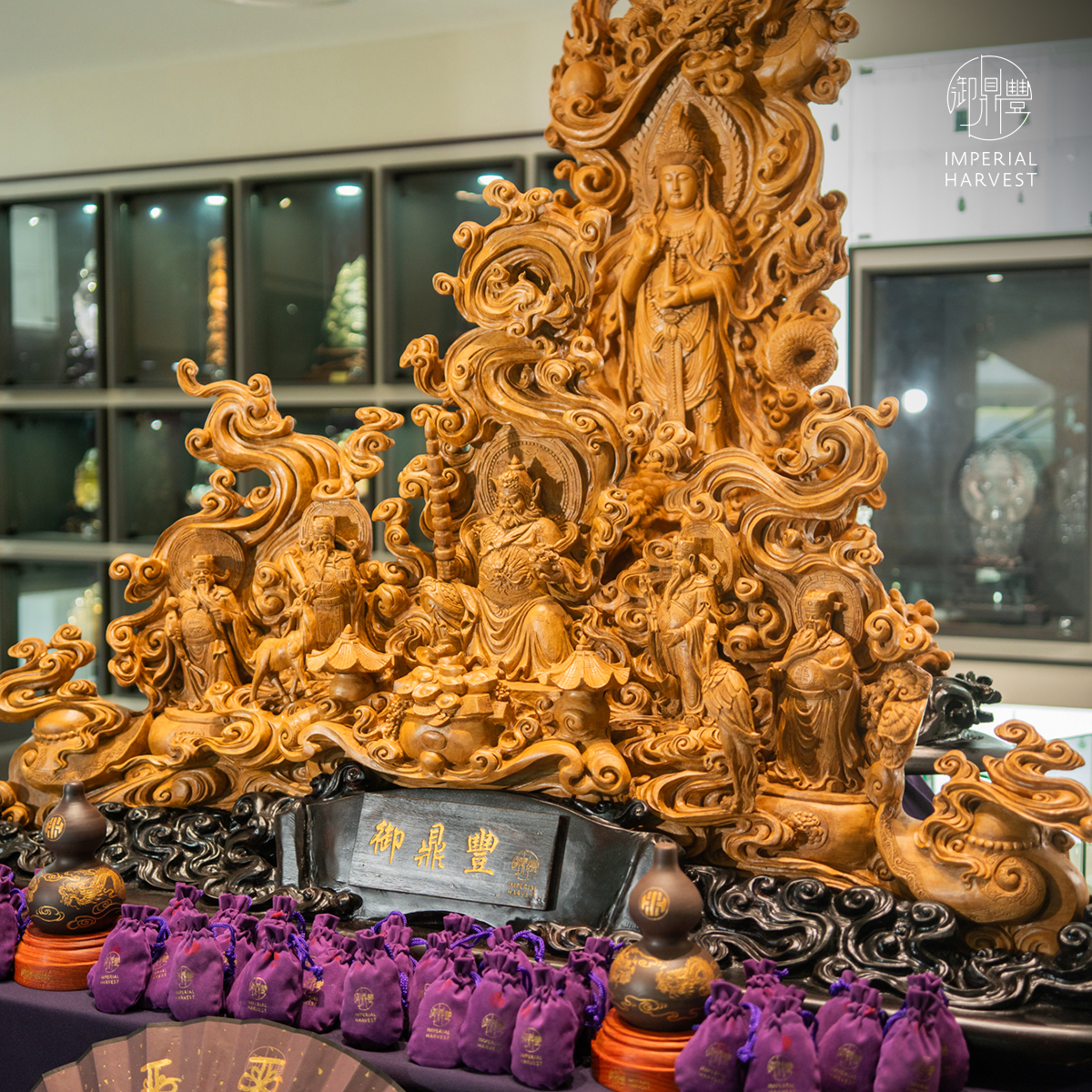
The carving presents all five wealth gods in their sovereign assembly — Zhao Gong Ming at the enthroned centre, flanked by the four directional deities, the entire composition rising from a sea of sacred clouds and auspicious flames. This is the sole instrument in Grand Master David Goh’s ceremonial suite through which the unified authority of all five wealth deities is channelled simultaneously into the consecration of a client’s treasure. No piece passes through a Five Wealth Gods blessing without making contact with this anchor.
The Imperial White Inkstone Five Wealth Gods Seals
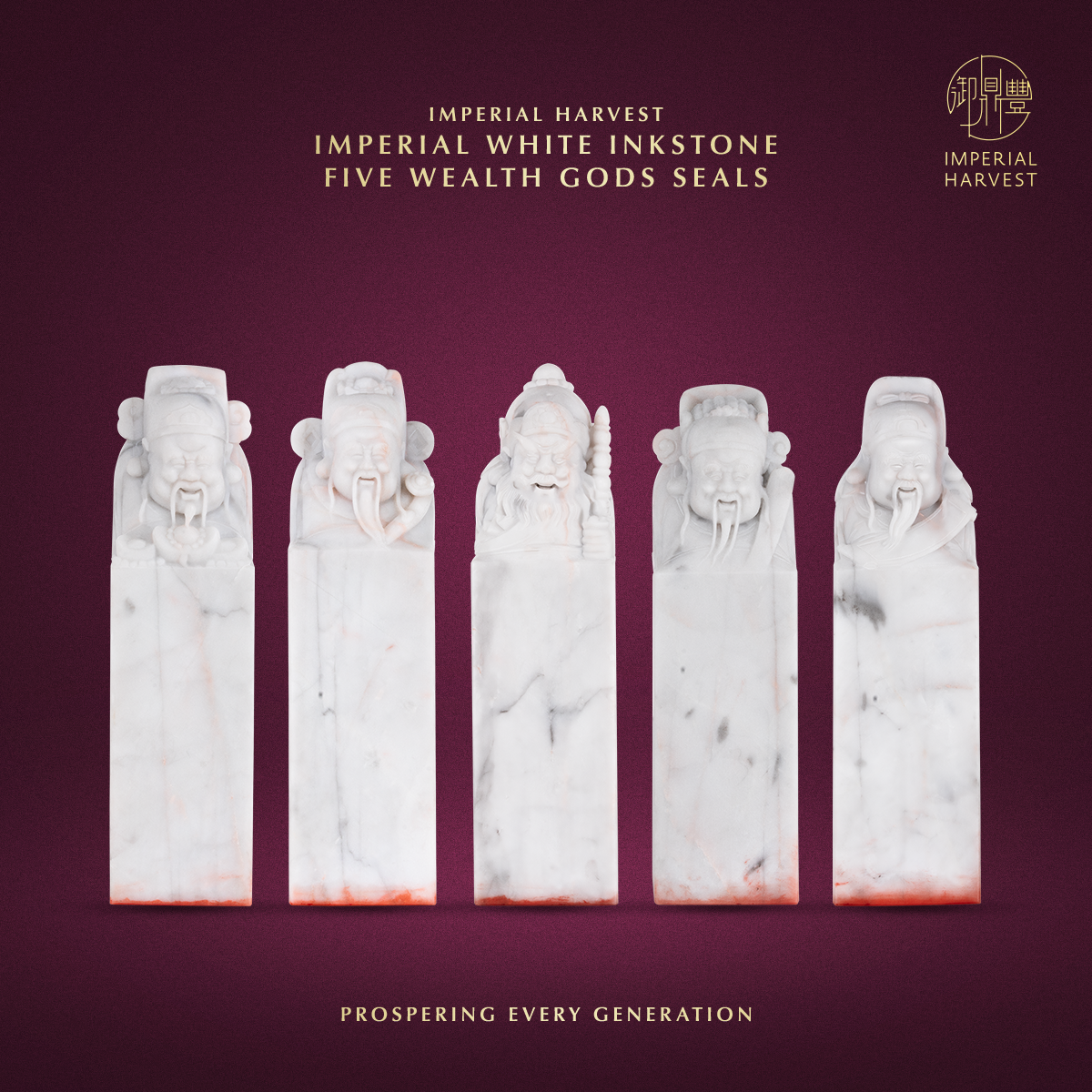
Companion to the ceremonial anchor — and unique within the consecration tradition — are Grand Master David Goh’s Imperial White Inkstone Five Wealth Gods Seals (御用白端五路财神印章). Five individually carved seals, each bearing the sculpted likeness and celestial authority of one specific wealth god, mounted in sequence from East to North.
Imperial White Inkstone is the most sovereign inkstone material in Chinese dynastic history. Reserved exclusively for the personal use of the Chinese Emperor, it was the material through which imperial edicts were authenticated — the physical substrate on which the Mandate of Heaven was made manifest in written form. An imperial seal pressed in Imperial White Inkstone ink was not a signature. It was the highest terrestrial authority confirming that a decree carried Heaven’s endorsement. No other material carried equivalent institutional gravity in the imperial Chinese world.
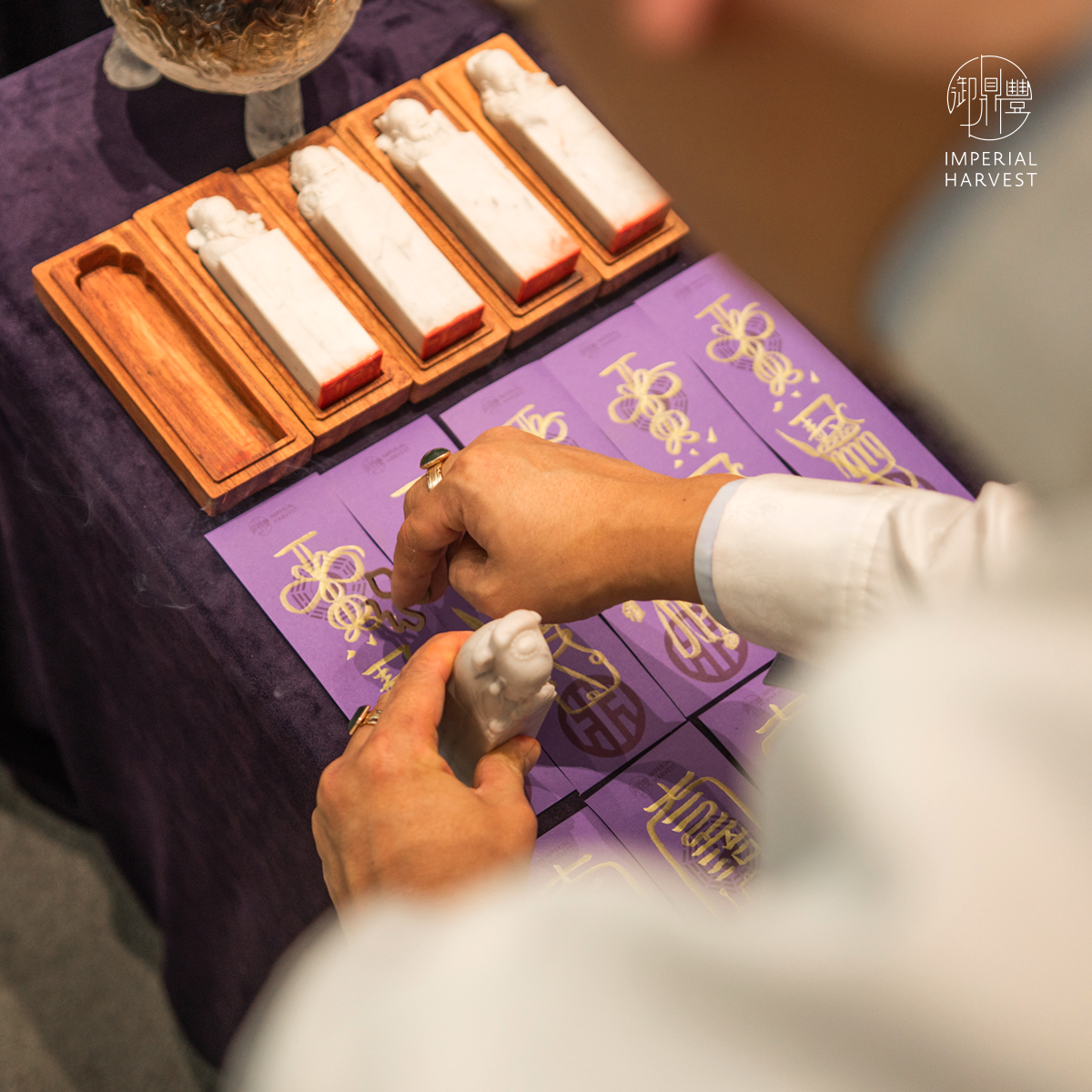
Grand Master David Goh’s choice of Imperial White Inkstone for these five seals is deliberate at every level. When he hand-draws a bespoke talisman for a client’s treasure, each of the five seals — Xiao Sheng, Chen Jiu Gong, Zhao Gong Ming, Cao Bao, Yao Shao Si — is pressed onto the talisman in its directional sequence. Each impression authenticates the corresponding wealth domain with the emperor-grade authority of the seal itself. The talisman, once sealed, carries not one blessing but five — each one stamped under the sovereign weight of the material that once authenticated the decrees of the Middle Kingdom.
Grand Master David Goh’s Five Wealth Gods Talismans
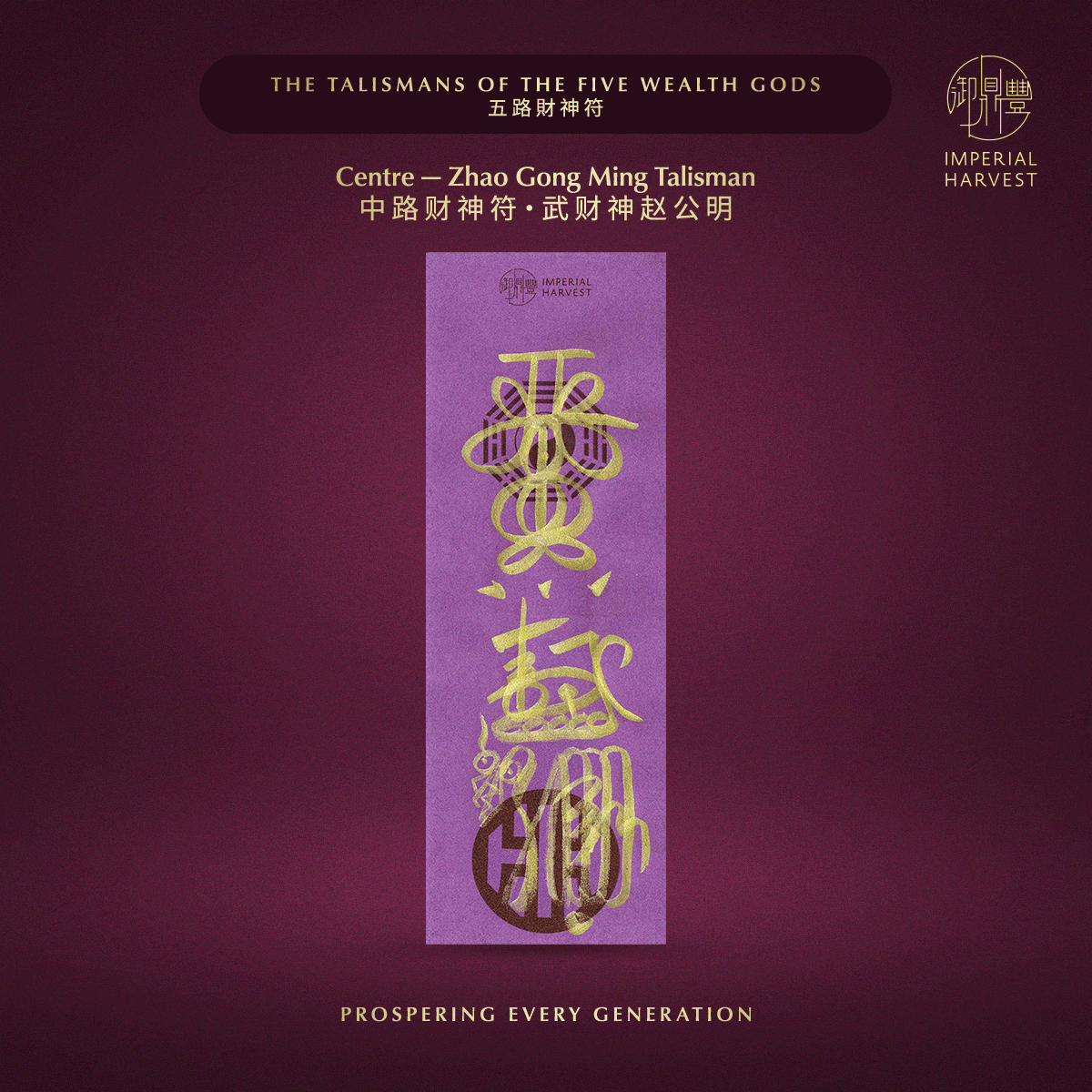
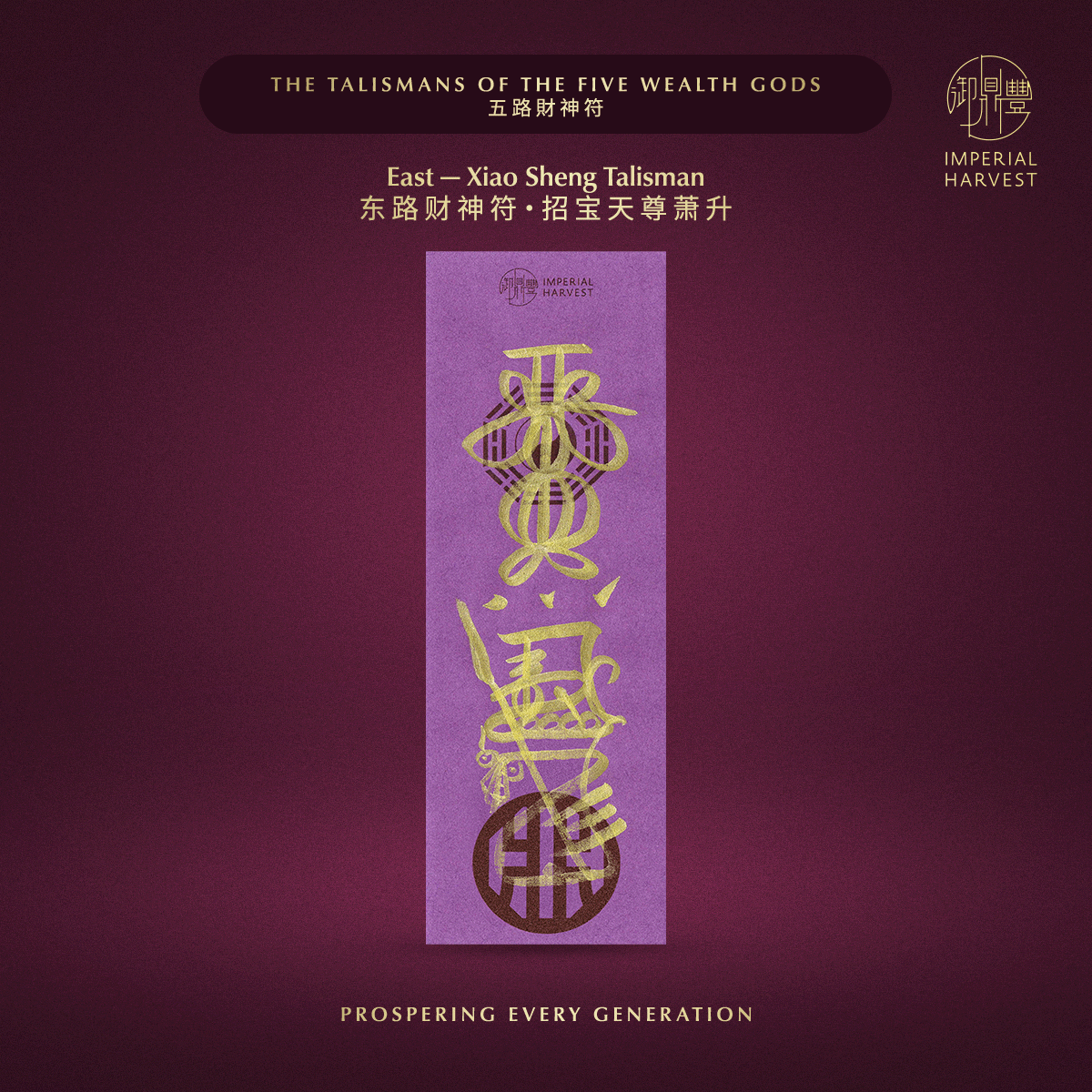
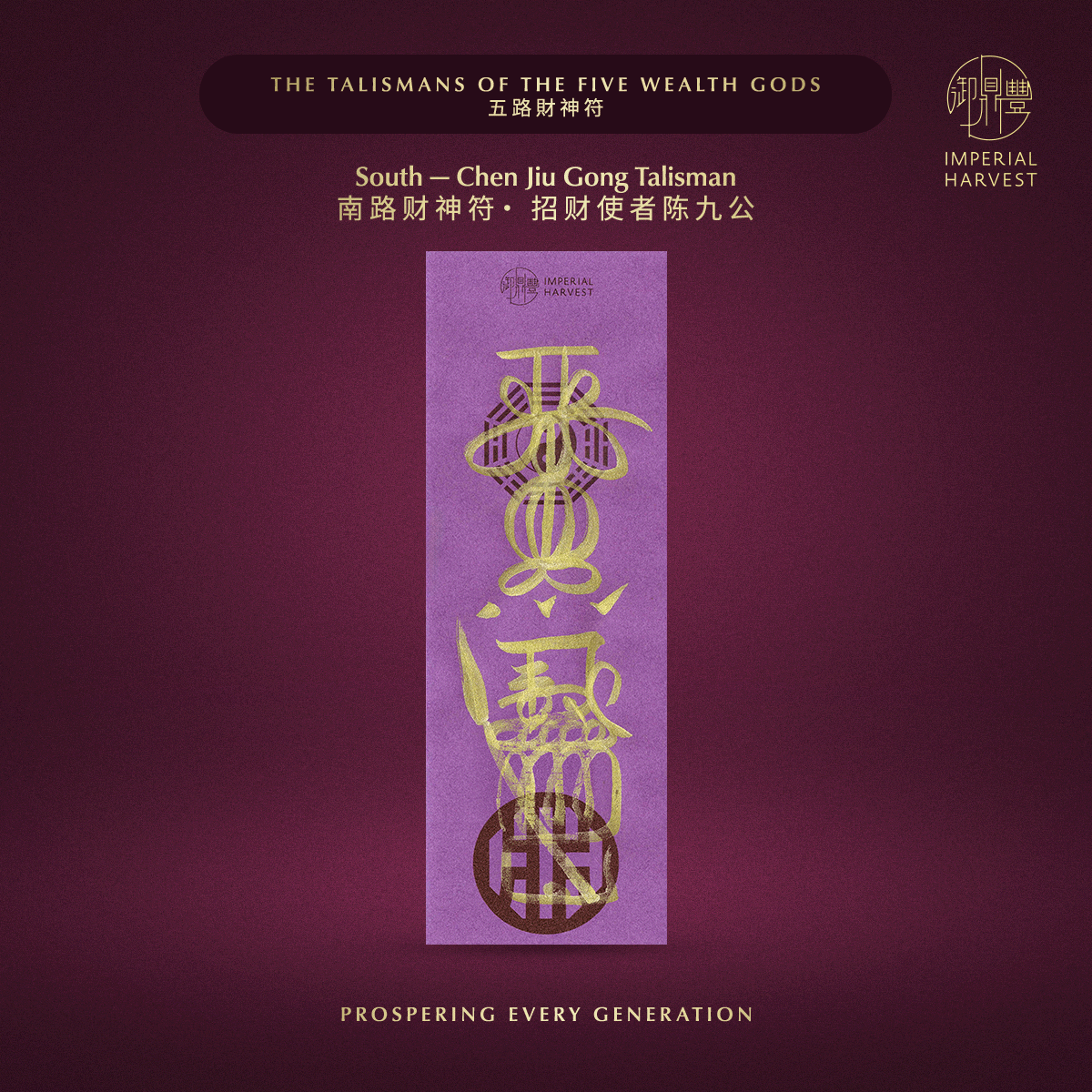
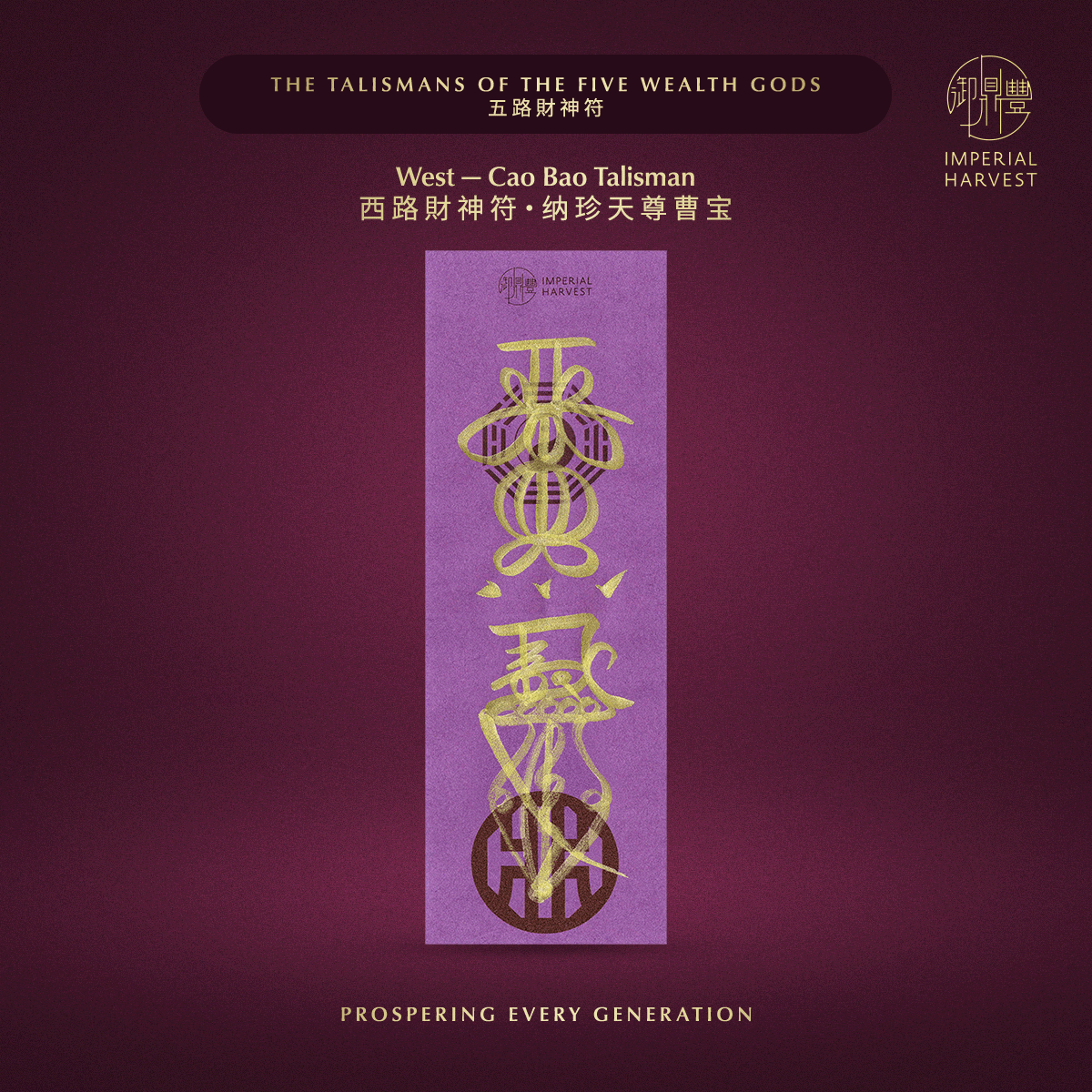
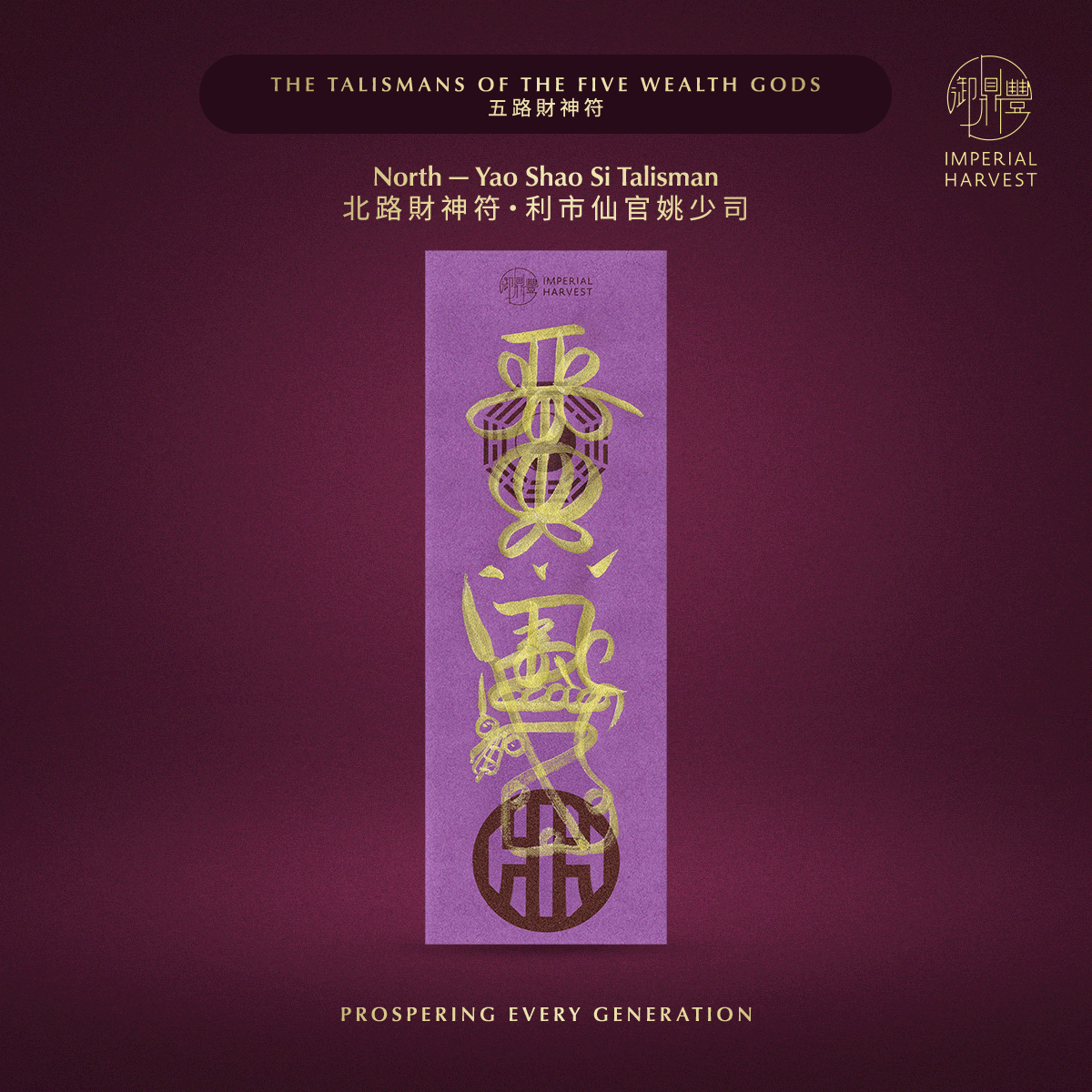
The third sovereign instrument of the ritual is the set of Five Wealth Gods Talismans (五路财神符) — five imperial talismans, one for each of the five wealth gods, each drawn in the canonical form preserved through the imperial Feng Shui lineage. These are not bespoke to individual clients. They are the codified celestial language through which each of the five wealth gods has been formally invoked for generations — the standardised script by which the sovereign authority of Zhao Gong Ming, Xiao Sheng, Chen Jiu Gong, Cao Bao, and Yao Shao Si is called from the celestial register to the altar.
What makes these talismans an Imperial Harvest instrument is not variation but authorship. Grand Master David Goh draws every one of the five, by his own hand, in preparation for every consecration he performs. The celestial language they encode is permanent. The authority they invoke is precise. The act of drawing them — stroke by stroke, in ink, by the master practitioner himself — is what converts the canonical form from a preserved tradition into a present and active invocation. A printed or reproduced talisman is an image. A talisman hand-drawn by the master for a specific consecration is a summoning prepared for that blessing alone.
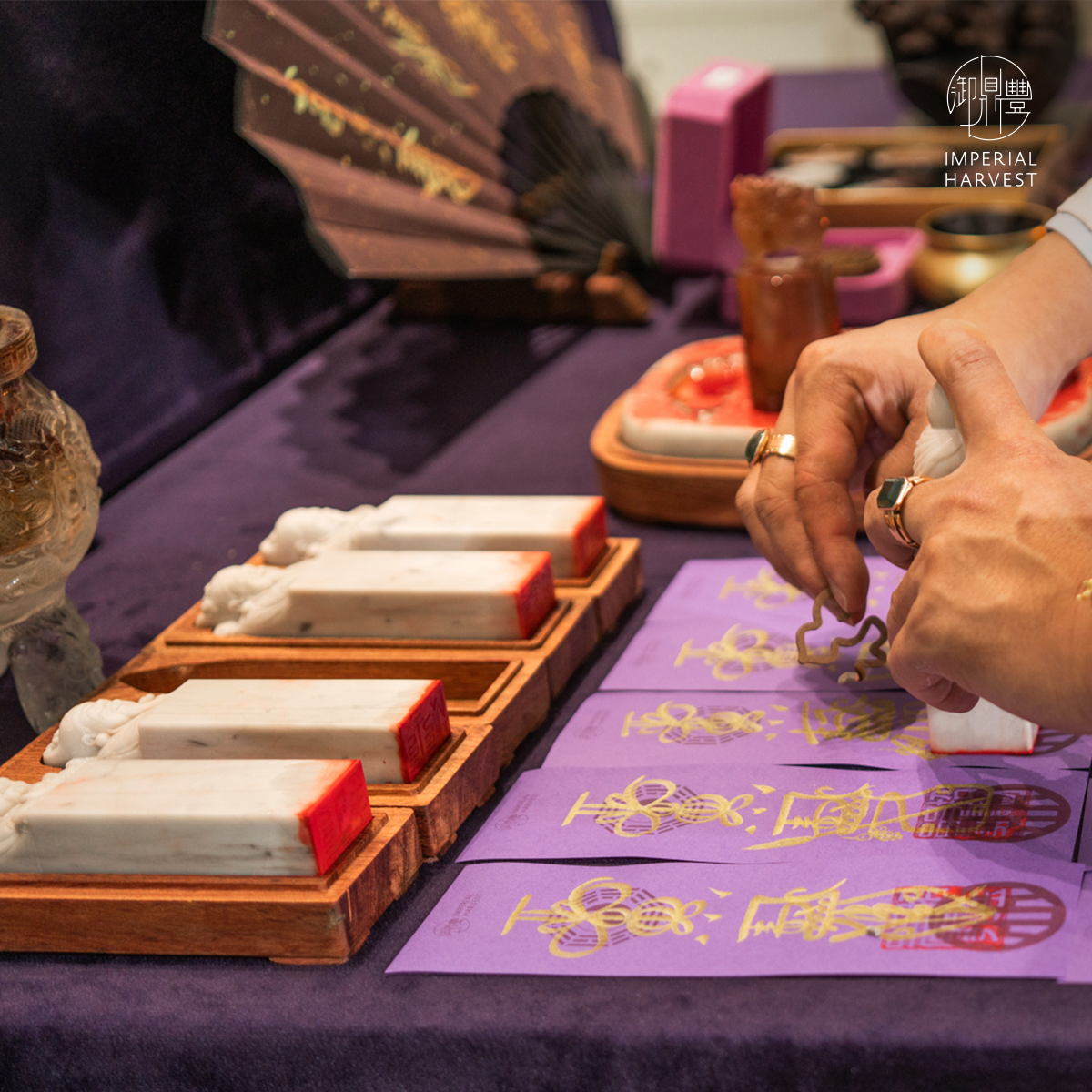
The Five Wealth Gods Talismans are the invocation layer of the ritual architecture. Where the ceremonial anchor channels the unified sovereign authority of all five deities, and the Imperial White Inkstone Seals authenticate each of the five domains with emperor-grade endorsement, the Five Wealth Gods Talismans are the formal summons — the imperial mechanism through which each wealth god is individually called, by name and by canonical form, into the space of the blessing. No wealth god arrives at the altar without first being invoked through their talisman. No Imperial Harvest consecration proceeds without all five having been hand-drawn by Grand Master David Goh’s own hand.
The anchor unifies. The seals authenticate. The talismans invoke. Three instruments of the highest order, conducted personally by Grand Master David Goh, converging on one client’s treasure to deliver the complete sovereign architecture of 财源广进.
Book A Free ConsultationThe Seven-Step Consecration Protocol
Every Imperial Harvest Five Wealth Gods blessing is conducted through a seven-step ritual protocol that Grand Master David Goh performs personally, at an auspicious hour calculated against the client’s own Bazi chart. No step is delegated. No step is abbreviated. No treasure is released until all seven have been completed in full.
Step One — Ignition of the Seven Star Candles
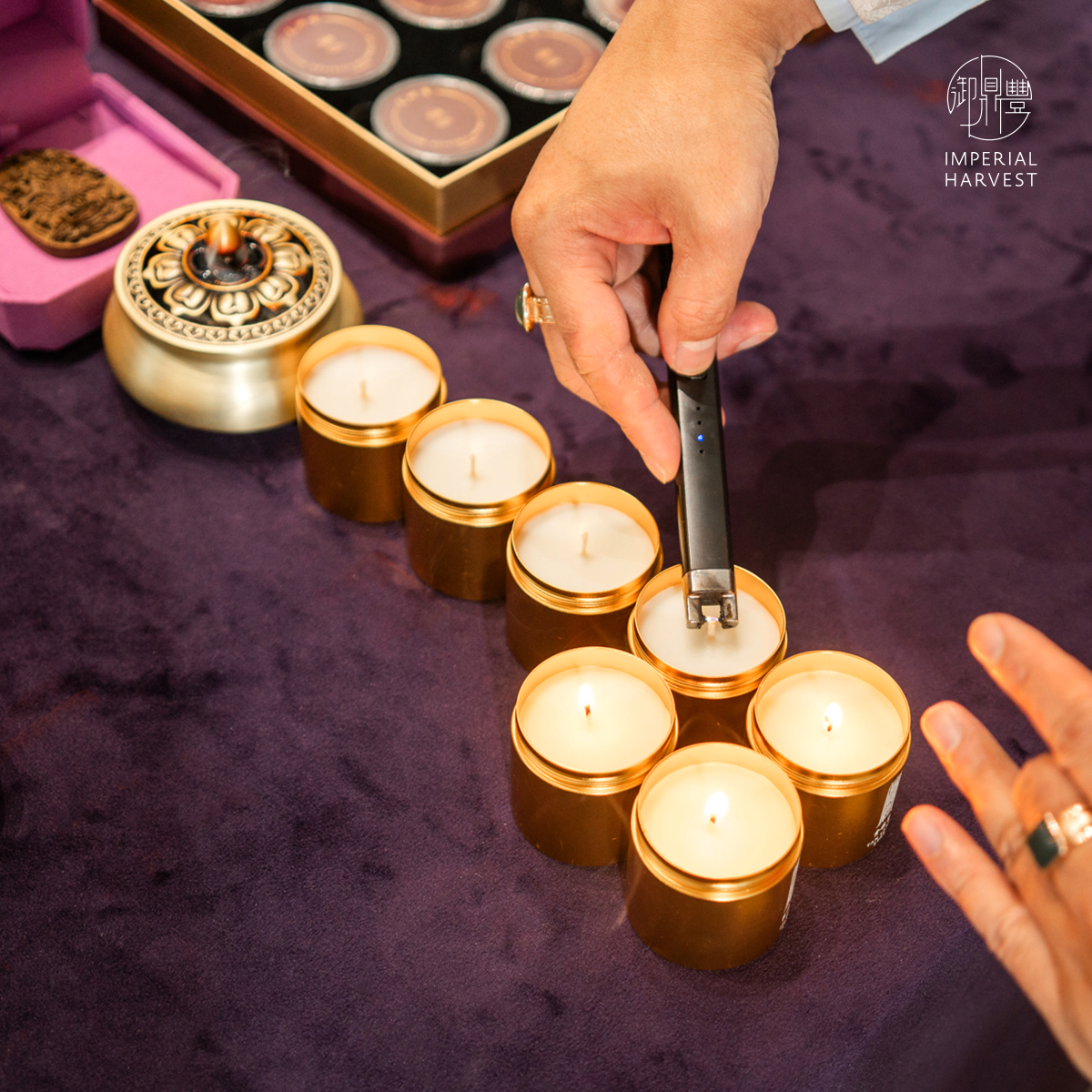
The ritual opens with the lighting of seven specially commissioned Big Dipper Constellation candles, arranged in the formation of the celestial pattern from which they draw their name. The Big Dipper, in Chinese cosmology, is the throne of the Emperor of Heaven — the fixed axis around which all fortune rotates. The seven flames establish the celestial alignment under which the blessing will be conducted.
Step Two — Lighting of the Sacred Agarwood Incense
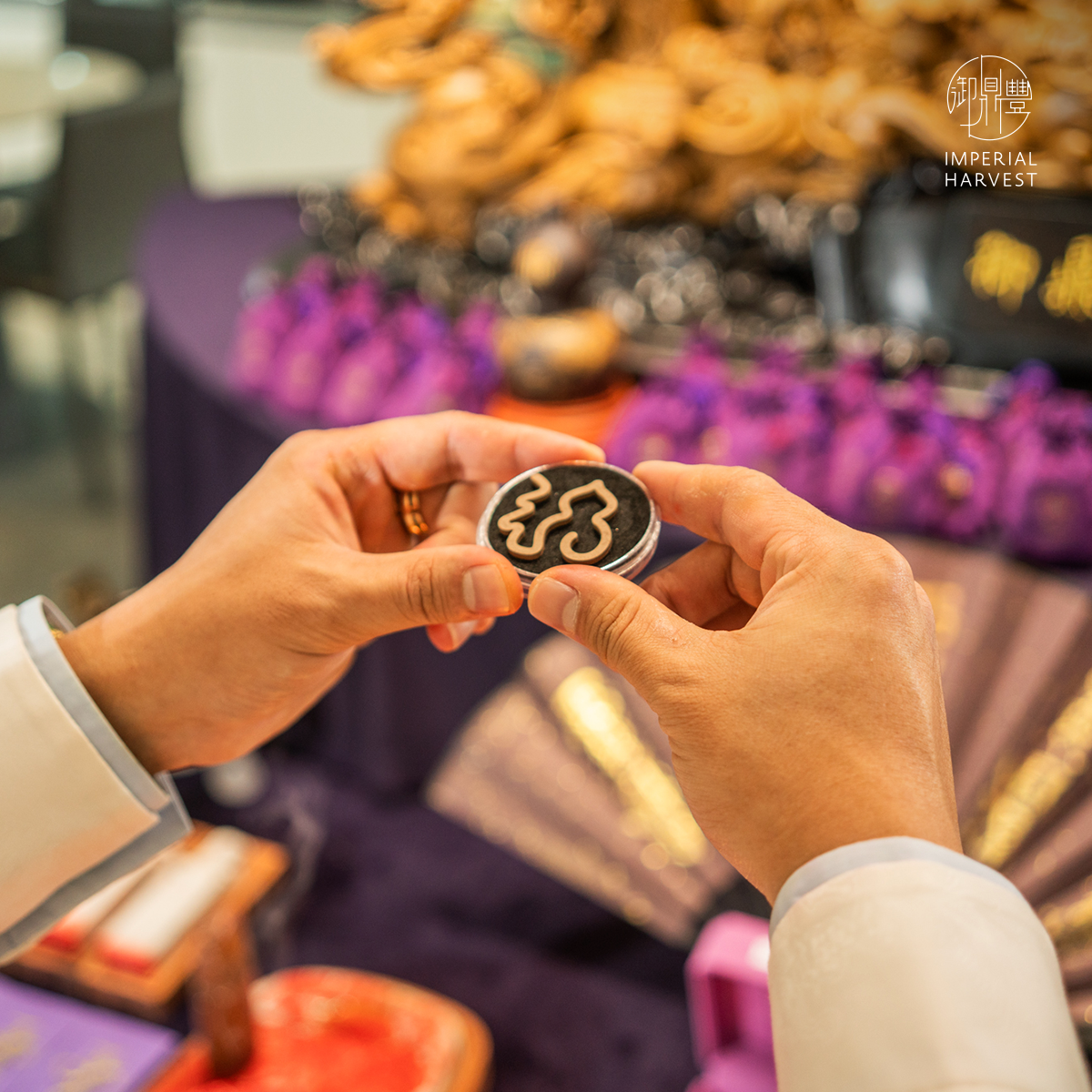
An incense formed in the shape of 福 (fú) — fortune — is lit. The incense is carved from the Triumphant Arrival Dark Earth Agarwood, Grand Master David Goh’s commissioned ceremonial agarwood, ensuring material continuity between the opening of the ritual and the sovereign authority that presides over it. The fragrance purifies the space and invites the five wealth deities to the altar.
Step Three — The Opening Incantation and the Invocation of the Five Wealth Gods
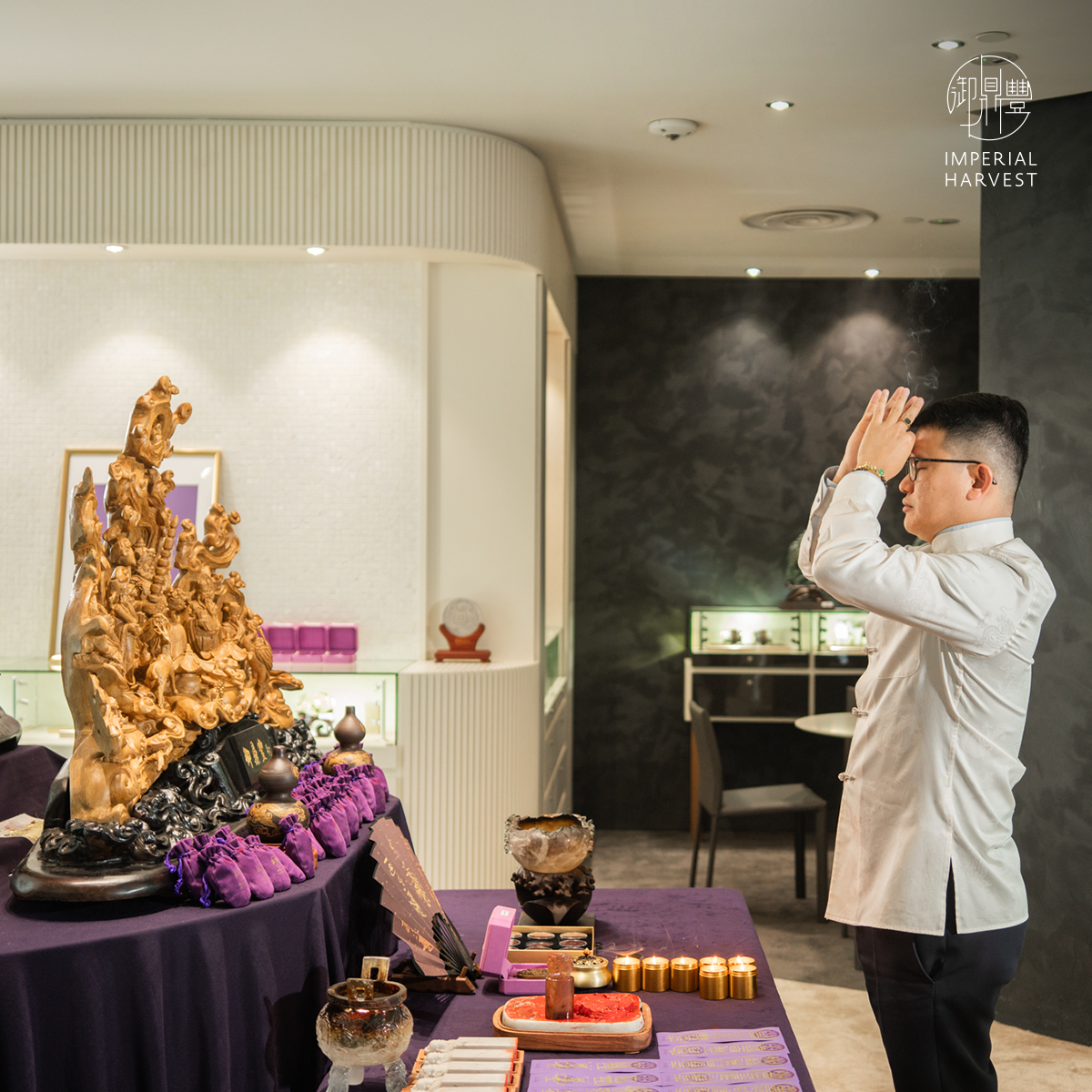
Grand Master David Goh recites the Opening Incantation to open the celestial portal between the five wealth gods and the space in which the blessing is being conducted. The incantation names each of the five deities in their directional sequence — Zhao Gong Ming at the sovereign centre, Xiao Sheng of the East, Chen Jiu Gong of the South, Cao Bao of the West, Yao Shao Si of the North — invoking each deity’s specific authority and requesting their presence at the altar. By the close of Step Three, the celestial portal is open, the five wealth gods are named and summoned, and the altar is attended by the complete sovereign administration of wealth under Heaven.
Step Four — Consecration of the Big Dipper Constellation Talismans and the Five Wealth Gods Talismans
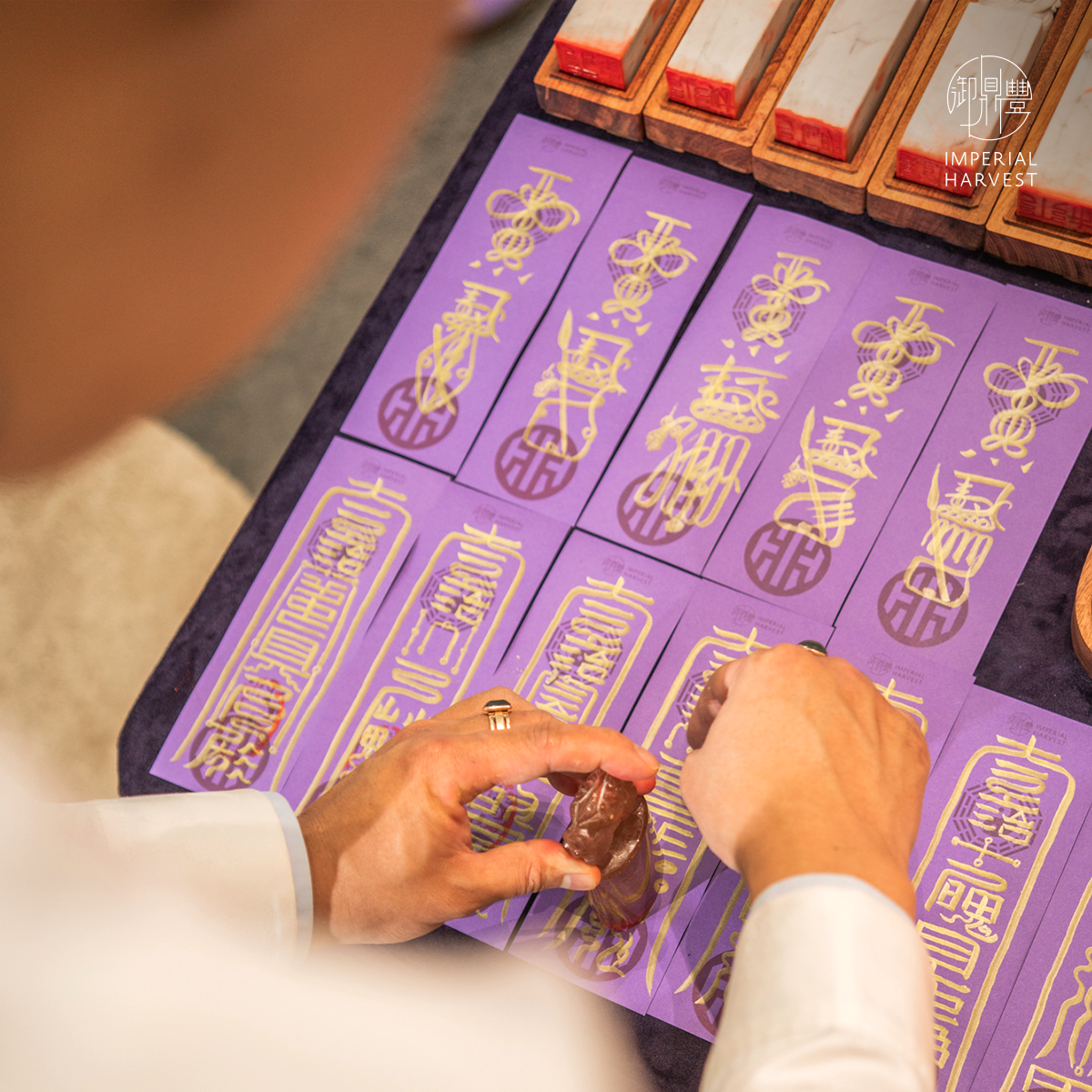
With the celestial portal open and the five wealth gods present at the altar, Grand Master David Goh proceeds to the consecration of the ritual’s two talisman sets — both hand-drawn by him in preparation for this blessing, and now brought forward to receive their sovereign authentication.
The Big Dipper Constellation Talismans (北斗七星符) — seven imperial talismans corresponding to the seven stars of the Big Dipper lit in Step One — are consecrated first, each stamped with the Imperial Harvest Seal carved from golden rutilated quartz. These talismans bind the blessing to the celestial axis around which fortune itself rotates, anchoring the ritual beneath the throne of the Emperor of Heaven.
The Five Wealth Gods Talismans are then consecrated alongside them, each one stamped with its corresponding Imperial White Inkstone Seal in the directional sequence from East to North. Every talisman is authenticated under the emperor-grade authority of the seal material that once authenticated the decrees of the Middle Kingdom.
Step Five — The Burning of the Talismans
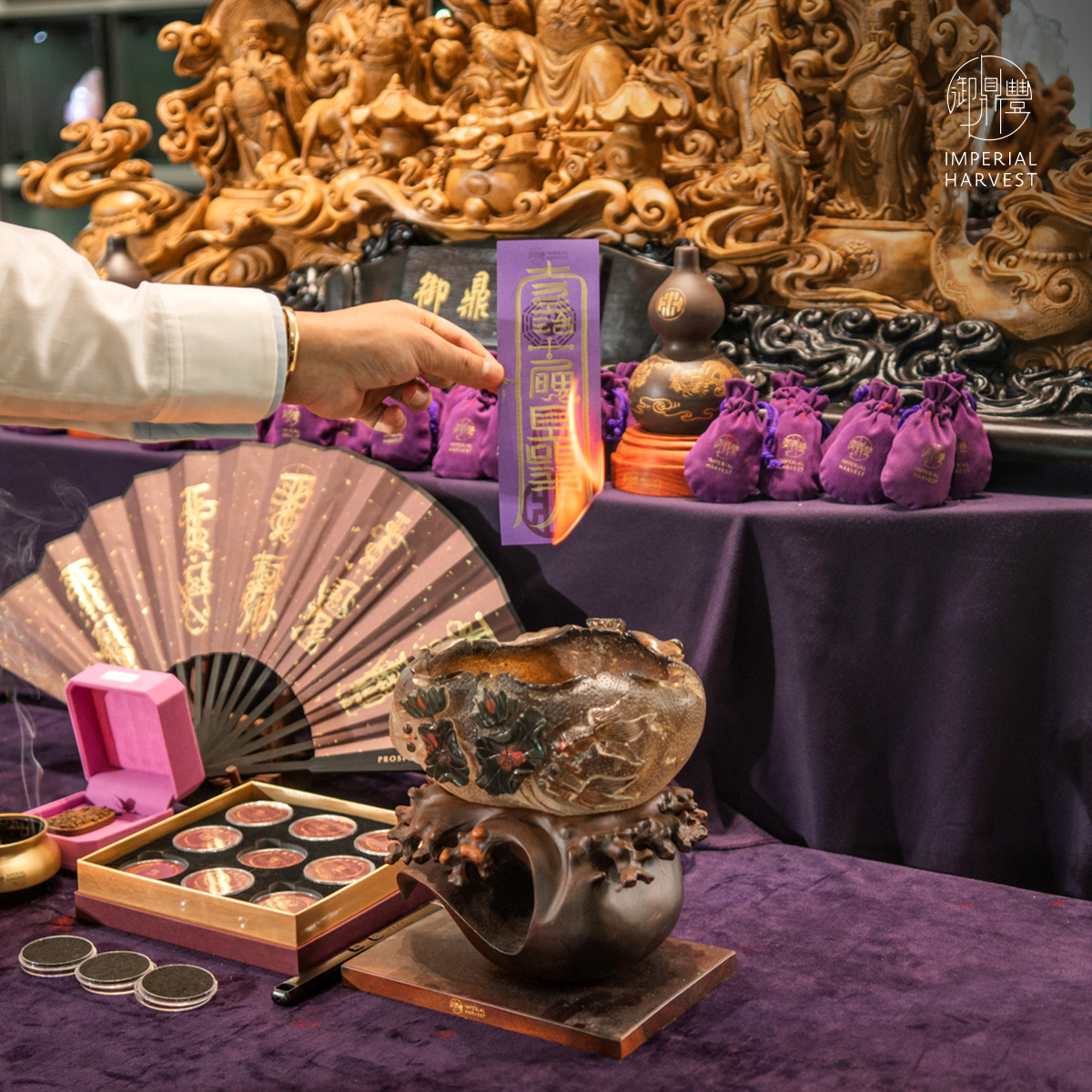
The consecrated talismans — the Big Dipper Constellation Talismans and the Five Wealth Gods Talismans — are committed to fire within the Imperial Harvest Crystal Cauldron. In imperial ritual tradition, the burning of a talisman is not destruction but transmission. The paper serves as the medium through which the inscribed invocation is conveyed from the terrestrial plane to the celestial. The smoke rising from the cauldron carries the full consecration upward — the celestial alignment of the Big Dipper and the sovereign invocation of the five wealth gods transmitted together to the heavenly register for direct endorsement. By the close of Step Five, the blessing has been received above. What follows is its descent into the treasure below.
Step Six — The Blessing of the Treasure
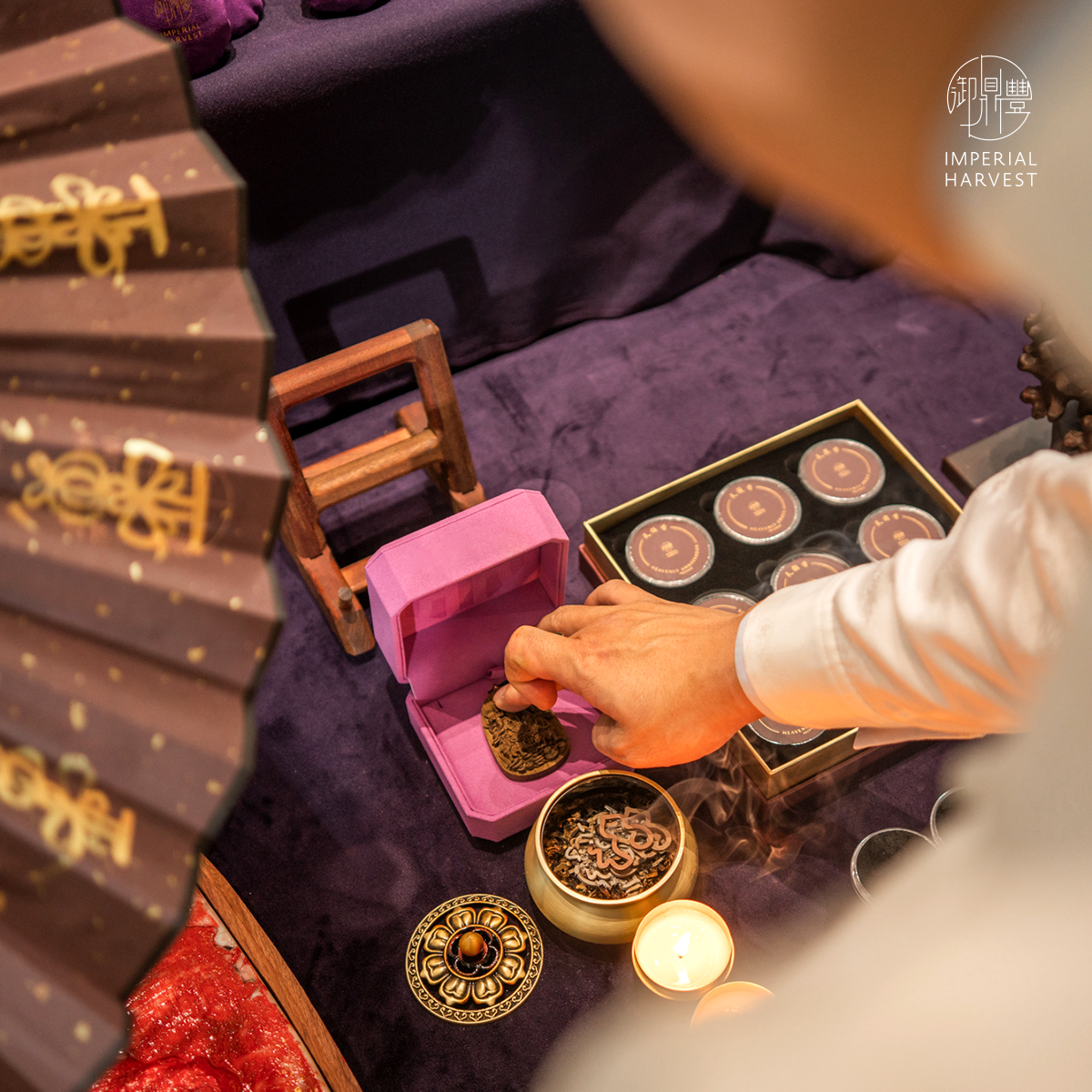
The client’s Imperial Harvest treasure is placed in front of the Imperial Harvest Red Earth Agarwood Five Wealth Gods Ceremonial Anchor. Grand Master David Goh anoints the treasure with the Imperial Harvest ceremonial vermillion — his personally concocted vermillion formulated with agarwood and sandalwood essences — applying it by his own hand along the specific inscription pattern of that piece’s bespoke talisman. The blessing incantation is recited throughout. This is the moment at which the five-fold authority of the anchor, the five-fold authentication of the seals, and the celestial endorsement already transmitted through the burnt talismans are drawn together and sealed into the treasure itself. The blessing that has been received in heaven is now descended, by the master’s own hand, into the piece destined for the client.
Step Seven — The Closing Incantation
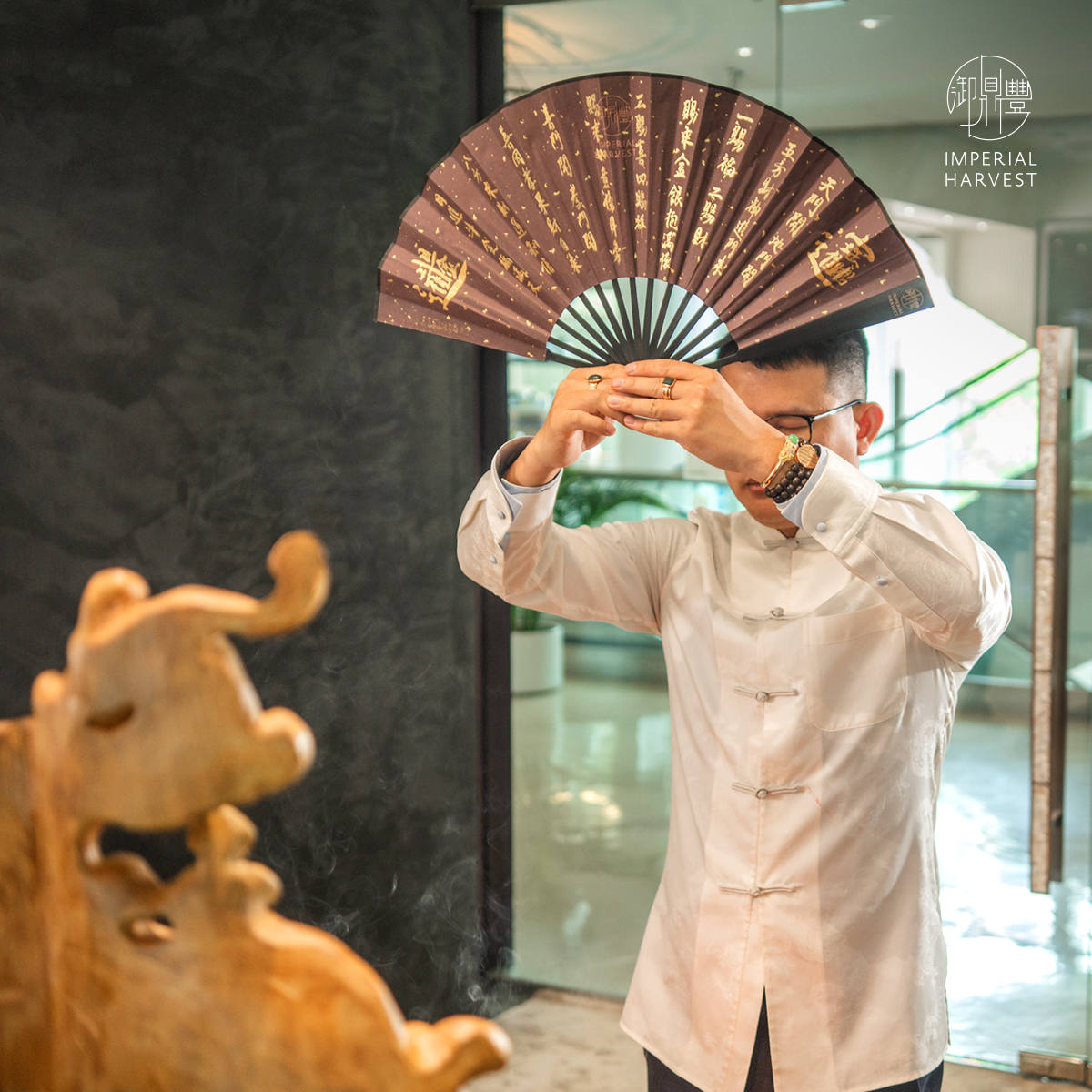
Grand Master David Goh recites the Closing Incantation, sealing the celestial portal and locking the consecrated authority into the treasure. From this moment, the piece carries the complete authority of all five wealth domains — active, stable, and calibrated to the destined owner’s personal Bazi chart — for the lifetime of the treasure.
Seven steps. One client. One treasure. One consecration conducted personally by Grand Master David Goh under the sovereign authority of the Red Earth Agarwood Ceremonial Anchor, the Imperial White Inkstone Seals, and the Five Wealth Gods Talismans drawn by his own hand. This is what it means to receive a Five Wealth Gods blessing at Imperial Harvest.
Book A Free ConsultationWhat This Means for Every Imperial Harvest Client
Owning an Imperial Harvest treasure that has passed through the Five Wealth Gods Blessing Ritual is not a symbolic acquisition. It is the physical and energetic outcome of a consecration architecture that operates at the highest material grade and the highest procedural rigour available within the imperial Chinese ritual tradition.
The Red Earth Agarwood Ceremonial Anchor unifies the sovereign tribute of all five wealth deities into a single instrument of blessing. The Imperial White Inkstone Seals authenticate each of the five pathways individually with emperor-grade endorsement. The Five Wealth Gods Talismans, hand-drawn by Grand Master David Goh in the canonical form preserved through imperial lineage, are the formal invocation through which each of the five wealth gods is summoned to the altar. The seven-step protocol ensures that every stage of the consecration — from the opening of the celestial portal to its sealing — is completed under Grand Master David Goh’s personal hand. And the bespoke talismans, consecrated and transmitted through fire for one specific client alone, anchor the entire blessing to the precise chart and aspirations of the destined owner.
The deeper wisdom of the Five Wealth Gods, however, lies not in their sovereign function but in the story of how they came to be unified. Former enemies and fallen disciples, bound together by Heaven’s decree into a single administration of wealth — the imperial tradition placed this narrative at the foundation of Chinese wealth theology for a reason. On the path of wealth, grudges must be set aside. Only cooperation produces mutual fortune. The five pathways through which wealth enters a life cannot be pursued one at a time, or against one another. They must flow together. That is what 财源广进 describes, and what the Five Wealth Gods Blessing Ritual is designed to establish.
The outcome is 财源广进 — wealth flowing in not from a single source but from all five simultaneously, not through the endorsement of one deity but through the unified tribute of five sovereign sources, not through a generic consecration but through a bespoke authentication that exists for this client alone.
This is what distinguishes Imperial Destiny Engineering Protocol (御用移星換斗 — the imperial art of shifting the stars and repositioning the Dipper) from destiny reading. Other practitioners interpret what your chart shows. Grand Master David Goh, through the Five Wealth Gods Blessing Ritual, activates what your chart has always been authorised to receive — from every source at once.
Your Next Step
The complimentary Bazi consultation with Grand Master David Goh takes sixty minutes. He reads every chart personally. In that time, he will identify your favourable element, diagnose which of the five sources of wealth are currently closed to you, and — where appropriate — prescribe the Imperial Harvest treasure whose consecration through the Five Wealth Gods Blessing Ritual will activate 财源广进 across the entire architecture of your destiny.
No obligation. No pressure. Just clarity.