TL;DR
Most people have had a Bazi reading — but most readings are algorithmic or advisory at best, not structural. Grand Master David Goh reads every chart personally in classical Chinese, producing a diagnosis of the four forces governing luck, intuition, direct wealth, and indirect wealth — and unlike a standard reading, his concludes not with advice, but with a map of what can actually be changed.
Why the chart that most Singaporeans have encountered online or at a fair is not the chart Grand Master David Goh reads — and why the difference determines what the reading can actually reveal.
Almost every Singaporean who takes an interest in Chinese metaphysics has, at some point, had their Bazi read. The experience is usually something like this: a birth date is provided, a chart appears on a screen or a sheet of paper, and a practitioner translates it into a handful of statements. Your favourable element is wood. Avoid the colour white this year. Your wealth stars are weak; prosperity will be moderate. Marriage is likely in your thirty-fourth year. The reading is fluent, plausible, and — the client often discovers months later — very difficult to act on in any structural way.
This is not the fault of the client, nor entirely of the practitioner. It is the consequence of a specific transmission problem. Bazi is one of the most sophisticated diagnostic systems ever developed by any civilisation — a five-thousand-year-old analytical framework that encodes the elemental architecture of a human life into four pillars of two characters each. When read by a master who understands what the framework is capable of producing, it can identify with remarkable precision which structural forces are supporting a person and which are suppressing them, which periods of their life will produce which conditions, and which specific constraints are governing outcomes they cannot explain through effort alone. When read by anyone else, it can produce the summary above.
The difference between the two readings is not a matter of accuracy. Both may be technically correct. The difference is what the reading is for. At the first-class tier of Imperial Feng Shui, a Bazi chart is read the way a cardiologist reads an echocardiogram: as structural diagnosis. At every tier beneath it, the same chart is read the way a horoscope is read: as interpretive guidance. The frameworks look identical from the outside. The outputs are categorically different.
What Bazi actually is
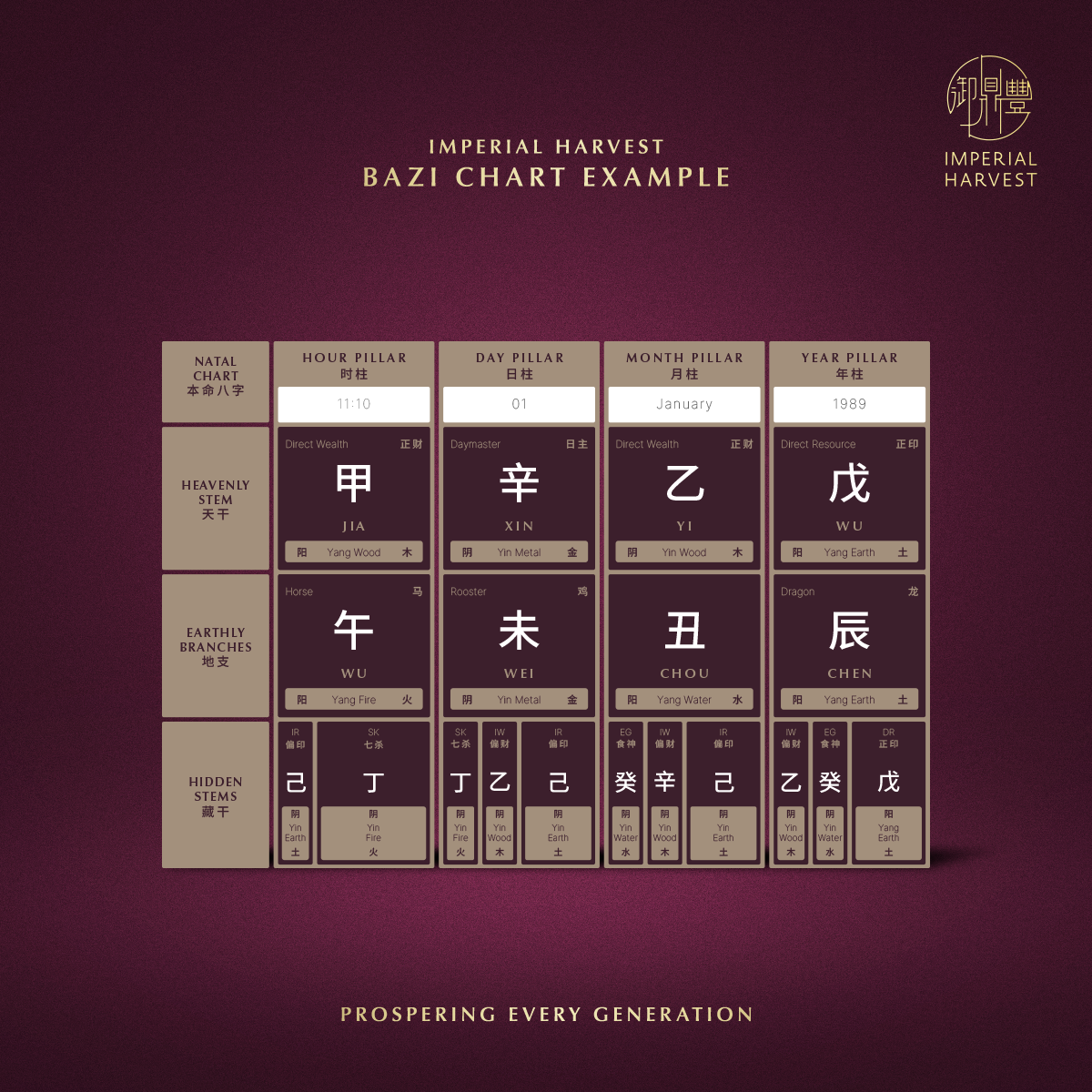
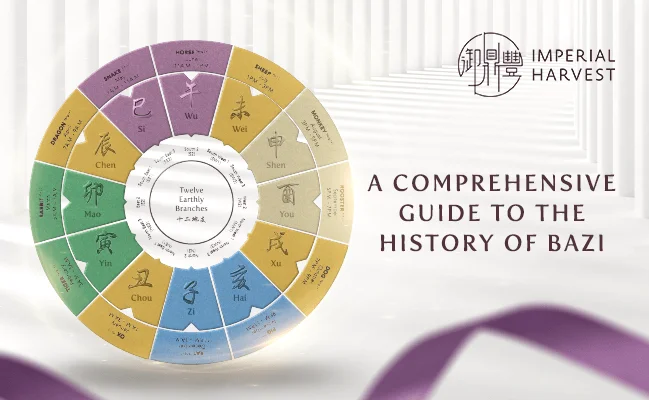
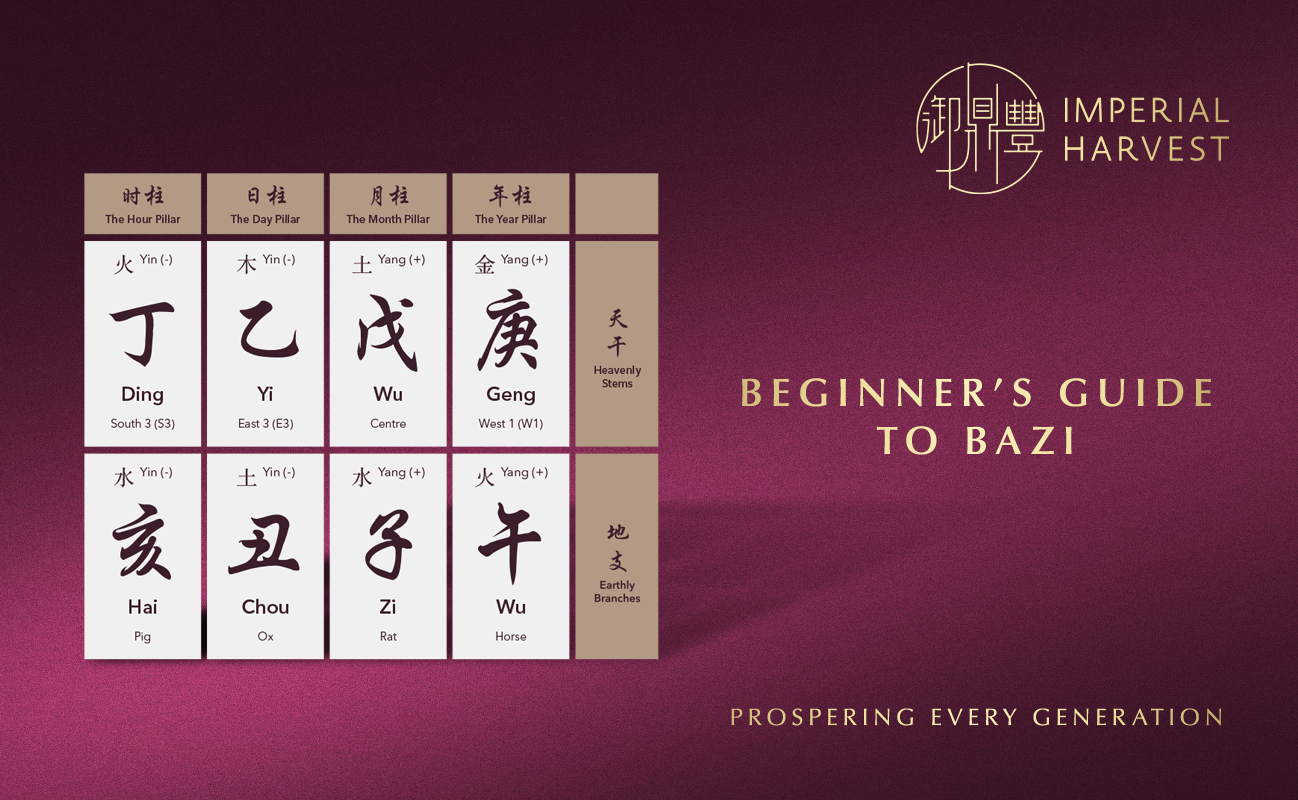
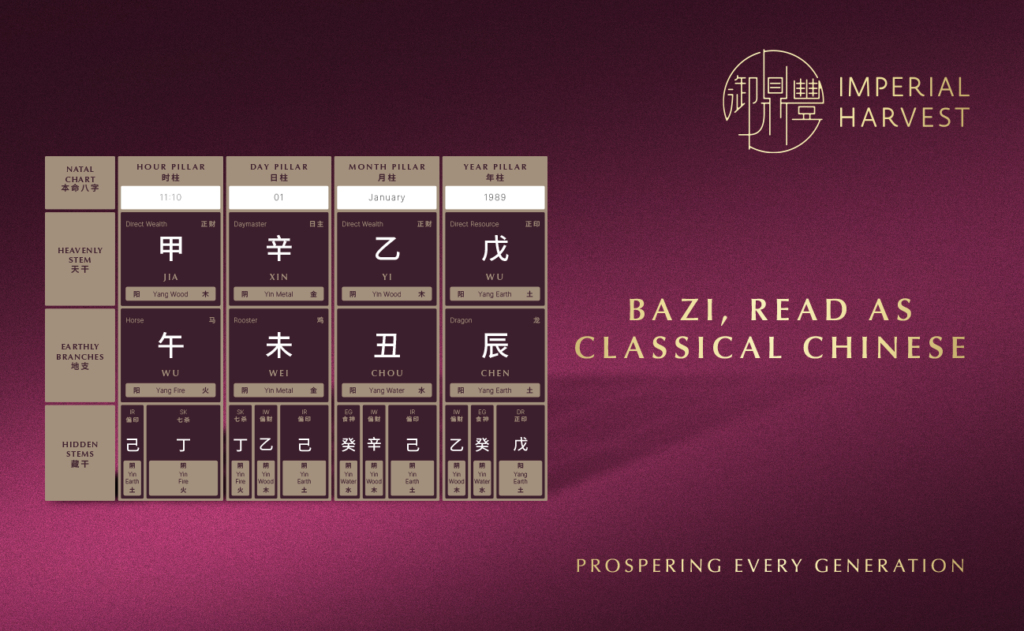
八字 — bā zì, literally eight characters — refers to the four pillars derived from the exact date, hour, month, and year of a person’s birth. Each pillar is composed of one Heavenly Stem (天干) and one Earthly Branch (地支), drawn from a cycle of ten stems and twelve branches that together articulate the elemental conditions present at the moment of birth. Two characters per pillar, four pillars in total — eight characters, hence the name.
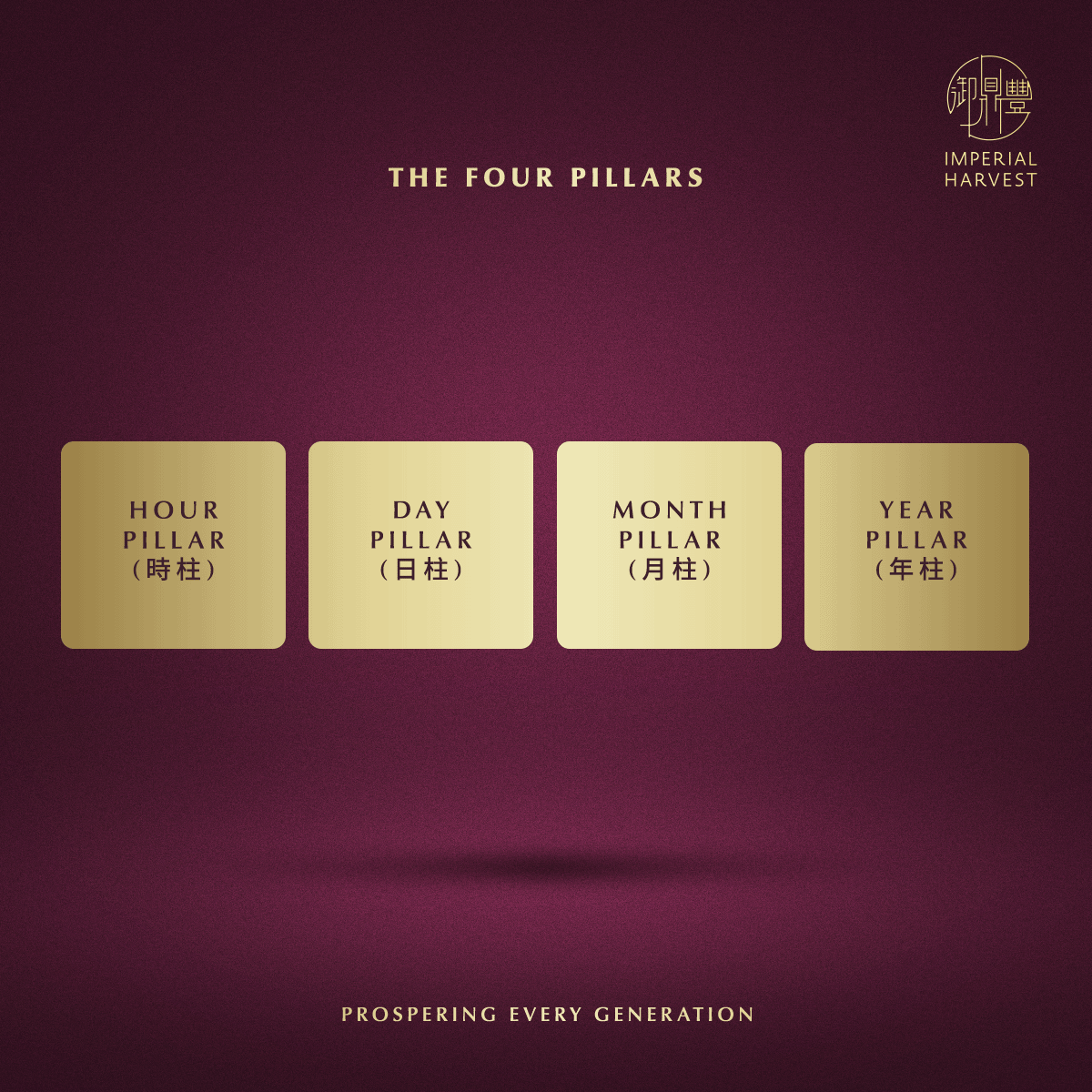
Each of these eight characters carries multiple layers of meaning simultaneously. A single Heavenly Stem encodes an element (Wood, Fire, Earth, Metal, or Water), a polarity (Yin or Yang), and a relationship to the other stems and branches present in the chart. A single Earthly Branch encodes its own element and polarity, plus hidden stems (藏干) that operate beneath the surface, plus a seasonal and animal designation that affects how the branch interacts with the other pillars across time. Read properly, a four-pillar chart is not eight pieces of data. It is an eight-element system whose internal relationships — supporting, controlling, draining, weakening — determine the structural architecture of the person the chart describes.
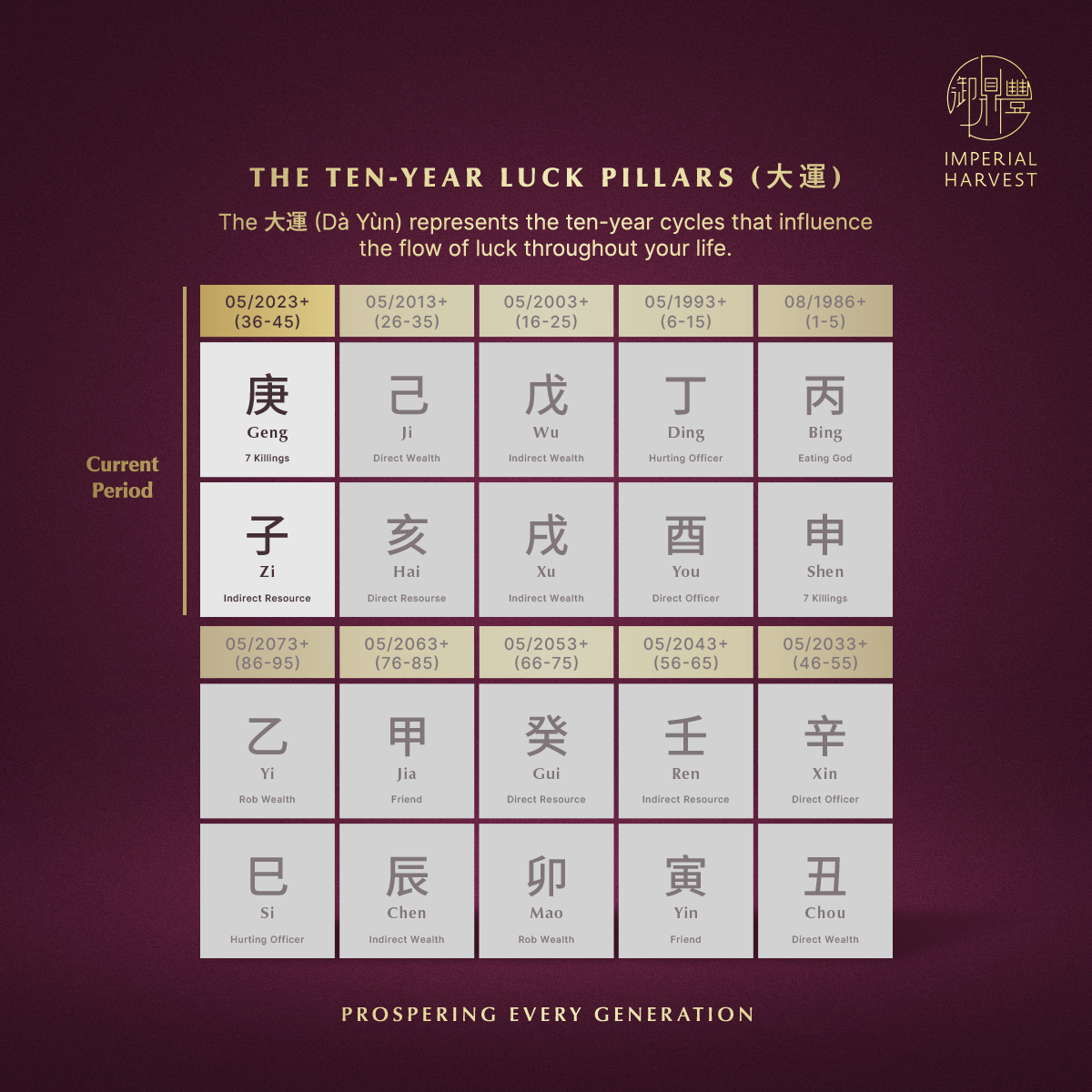
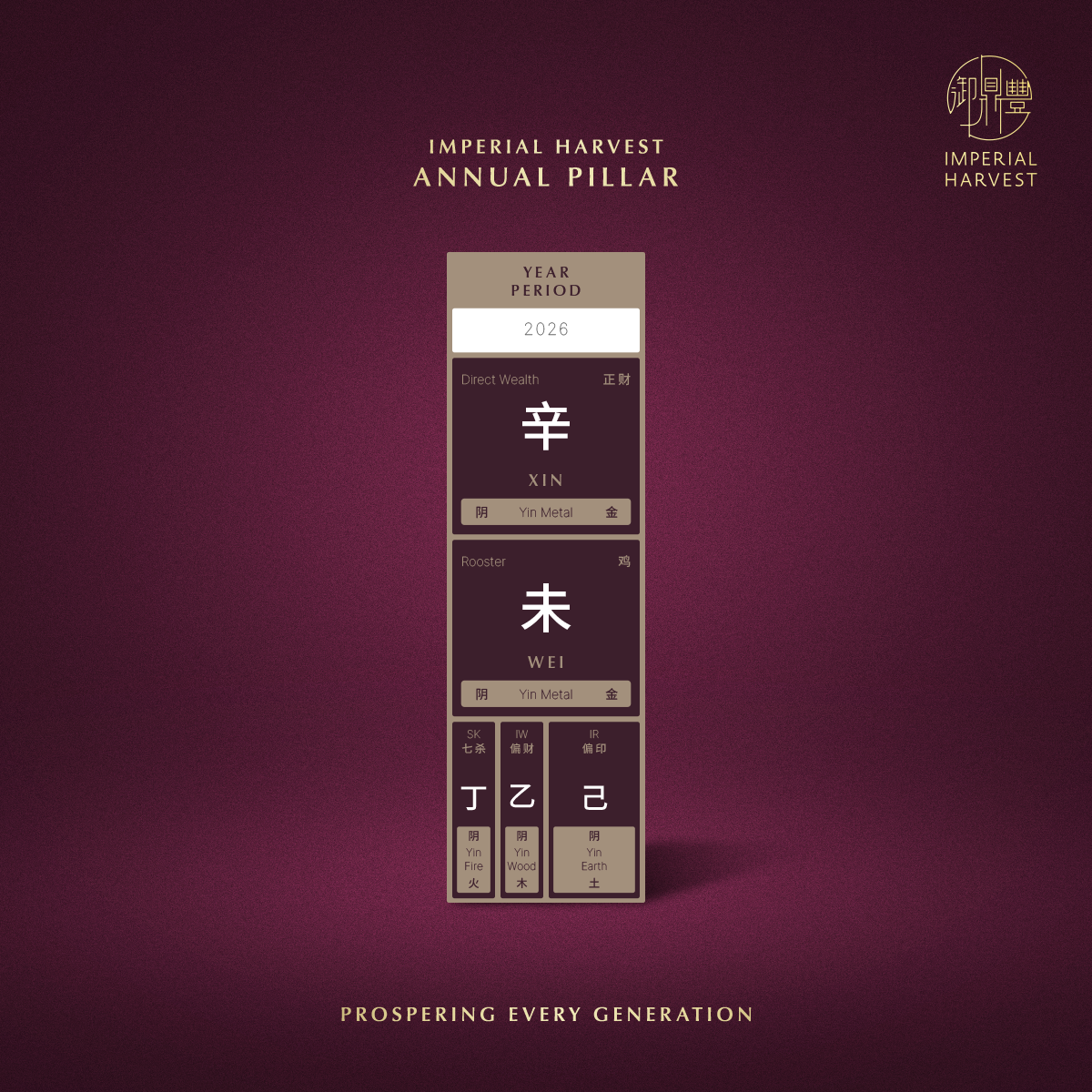
On top of this natal structure, two dynamic layers operate continuously: the 大运 — the ten-year luck pillars that shift the elemental environment of the chart every decade — and the annual pillar, which shifts each lunar year. A competent Bazi reading integrates all three: the natal architecture, the current decade’s luck pillar, and the current year’s elemental environment. What emerges is not a forecast. It is a diagnosis of the structural conditions the person is currently operating inside.
Book A Free Consultation
What most readings miss
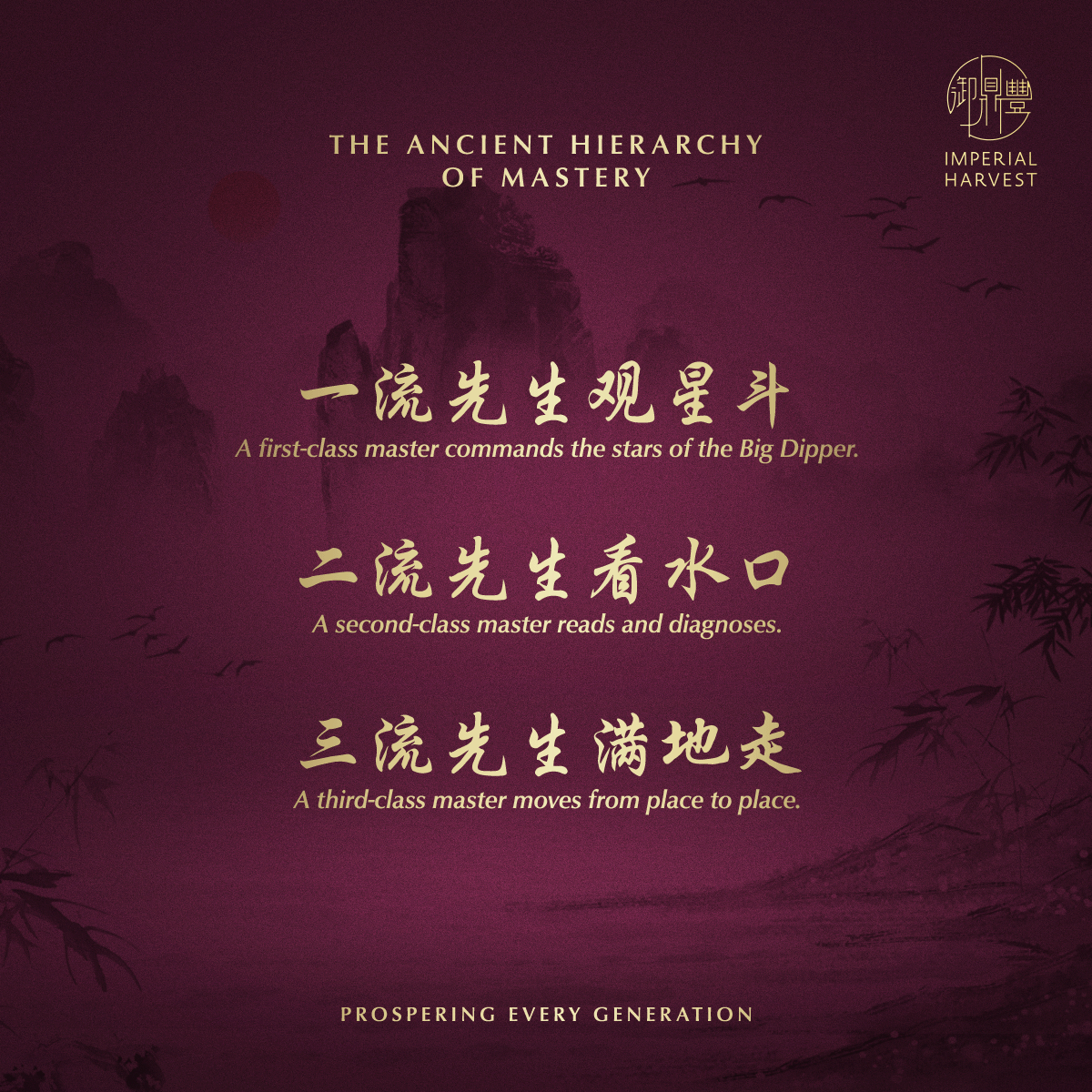
The problem with most contemporary Bazi readings is not that they are wrong. It is that they operate at a level of abstraction that cannot produce structural insight, however accurate the individual statements may be.
A software-driven reading, of the kind most commonly encountered through apps and online services, generates its output by matching chart configurations against pre-written interpretive templates. The templates are drawn from the classical literature and are, at their best, technically defensible. But the reading is algorithmic: input the chart, retrieve the relevant pre-written assessments, concatenate them into a personalised-feeling document. What the output cannot do — because no algorithm can — is synthesise the specific interaction of this person’s specific elemental configuration, operating under this year’s specific elemental environment, against the backdrop of this decade’s specific luck pillar shift. The chart is read. The synthesis that imperial Bazi requires is not performed.
A human reading at the second-class tier performs the synthesis, but typically within the diagnostic ceiling the tier permits. A skilled second-class practitioner will identify the chart’s strongest and weakest elements, name the current luck pillar’s effect, and issue advisory guidance — this is a favourable period for career advancement; that is an inauspicious window for investment. The synthesis is real. The advice is useful. What the reading does not do, because it cannot, is identify the specific structural forces that are producing the client’s most consequential outcomes and propose a mechanism for altering them. It reads the chart. It does not read the life the chart governs.
A reading that identifies what is wrong without proposing what can be changed is not a diagnosis. It is a summary.
— Grand Master David Goh
Imperial Bazi, read at the first-class tier, is structural from the first pillar. A first-class practitioner does not begin by asking what the client wants to know. He begins by reading the chart in its own terms — in the classical Chinese in which the system was articulated — and producing the structural diagnosis the chart actually contains. What is the Day Master’s strength? Which elements support it, which suppress it? What is the governing pattern — 从格, 专旺, 格局 — that determines how the chart expresses across time? Which palaces are supporting which outcomes? Where are the structural constraints that will hold the person at a specific ceiling regardless of effort, and where are the structural openings that will release when the luck pillar turns? The reading is a map of the chart’s architecture — and the architecture, once read, is what the practice goes on to address.
The Four Quadrants framework
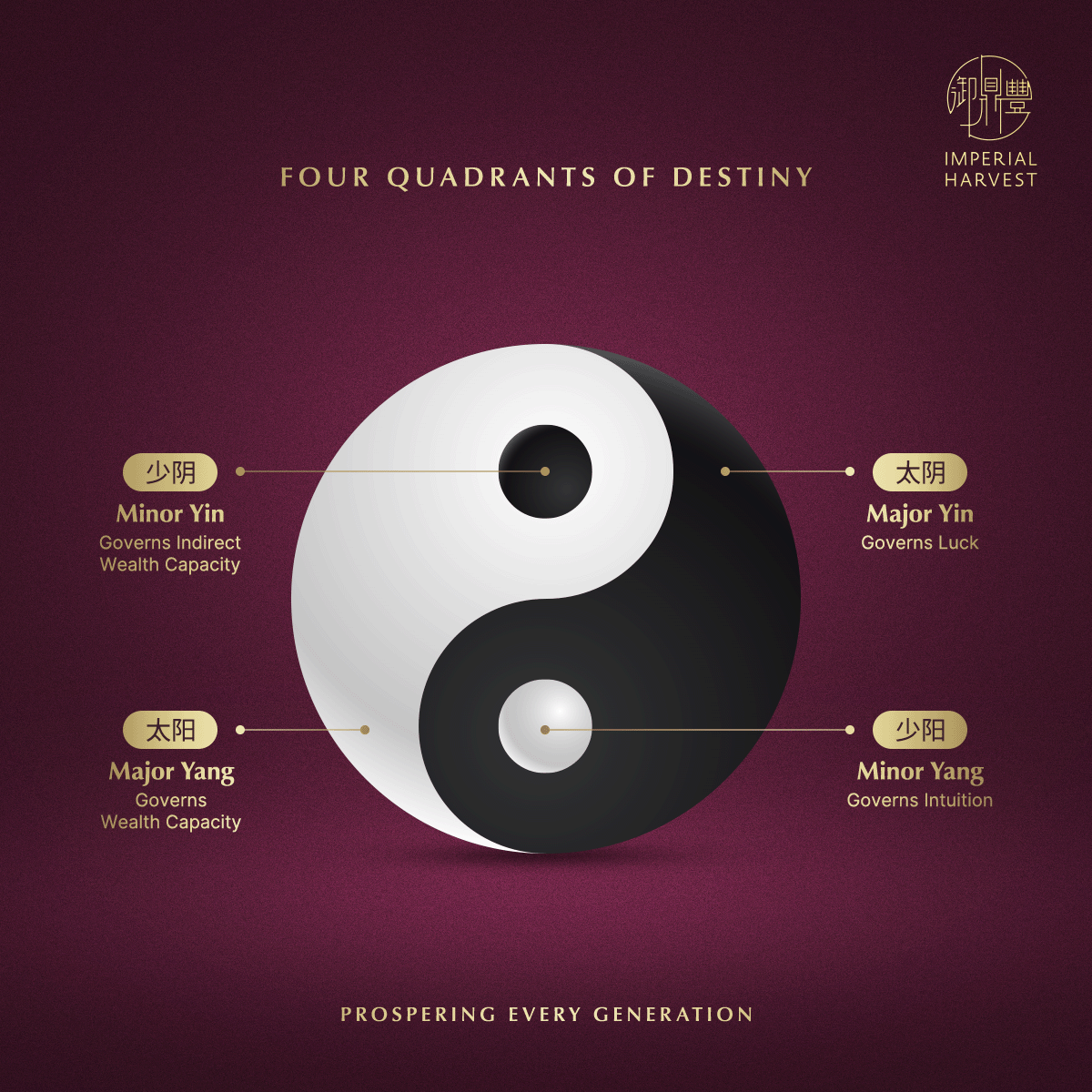
At Imperial Harvest, the structural diagnosis produced by imperial Bazi reading is organised into a framework Grand Master David Goh has developed across his years of practice: the Four Quadrants of Destiny. Each quadrant corresponds to one of four structural forces that together govern the most consequential dimensions of a person’s trajectory.
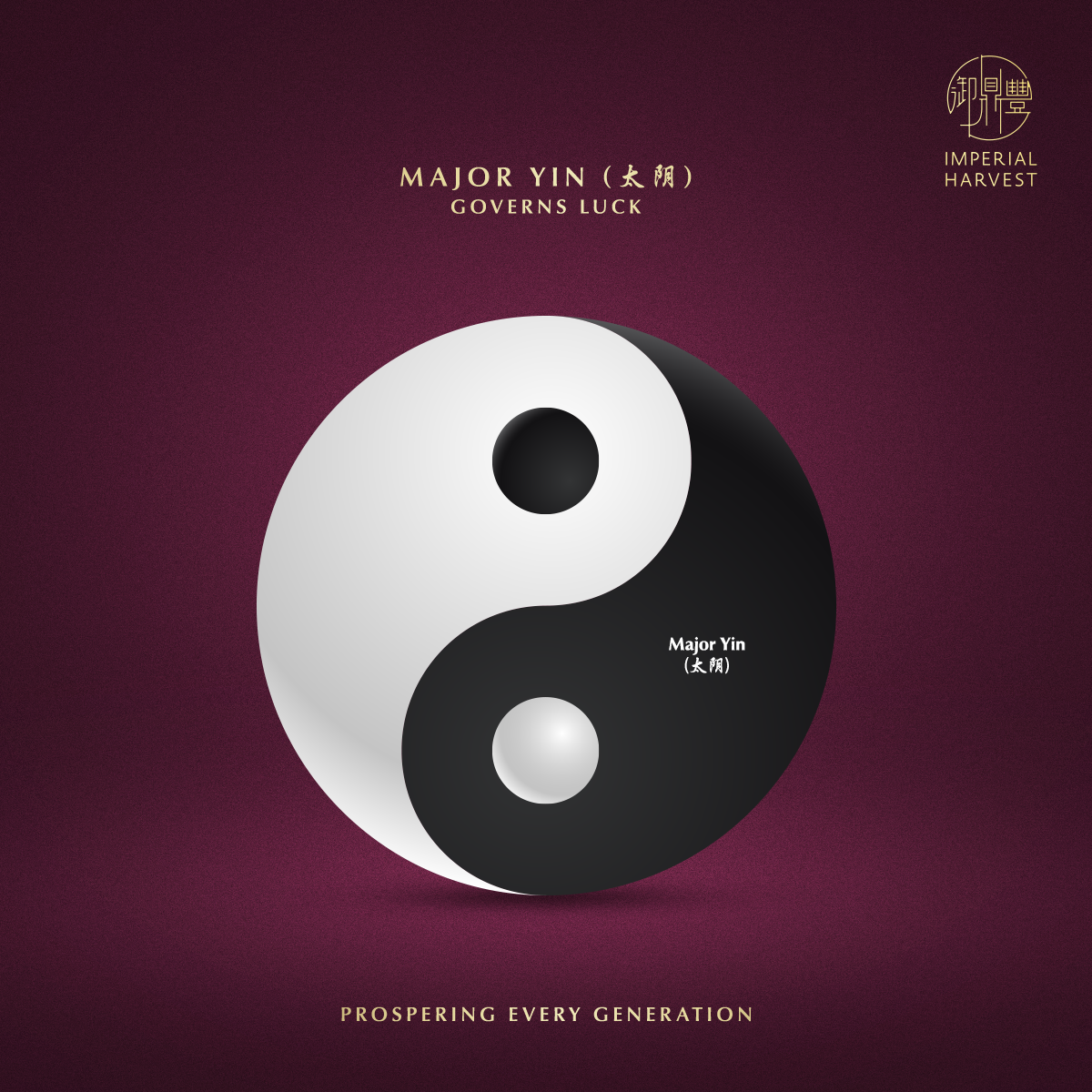
Major Yin (太陰) governs Luck — whether the environment cooperates with the person’s effort, or resists it. When Major Yin is aligned, doors open, timing works in the person’s favour, and the right people appear at the right moments. When Major Yin is constrained, the person does everything correctly and meets invisible resistance at every turn.
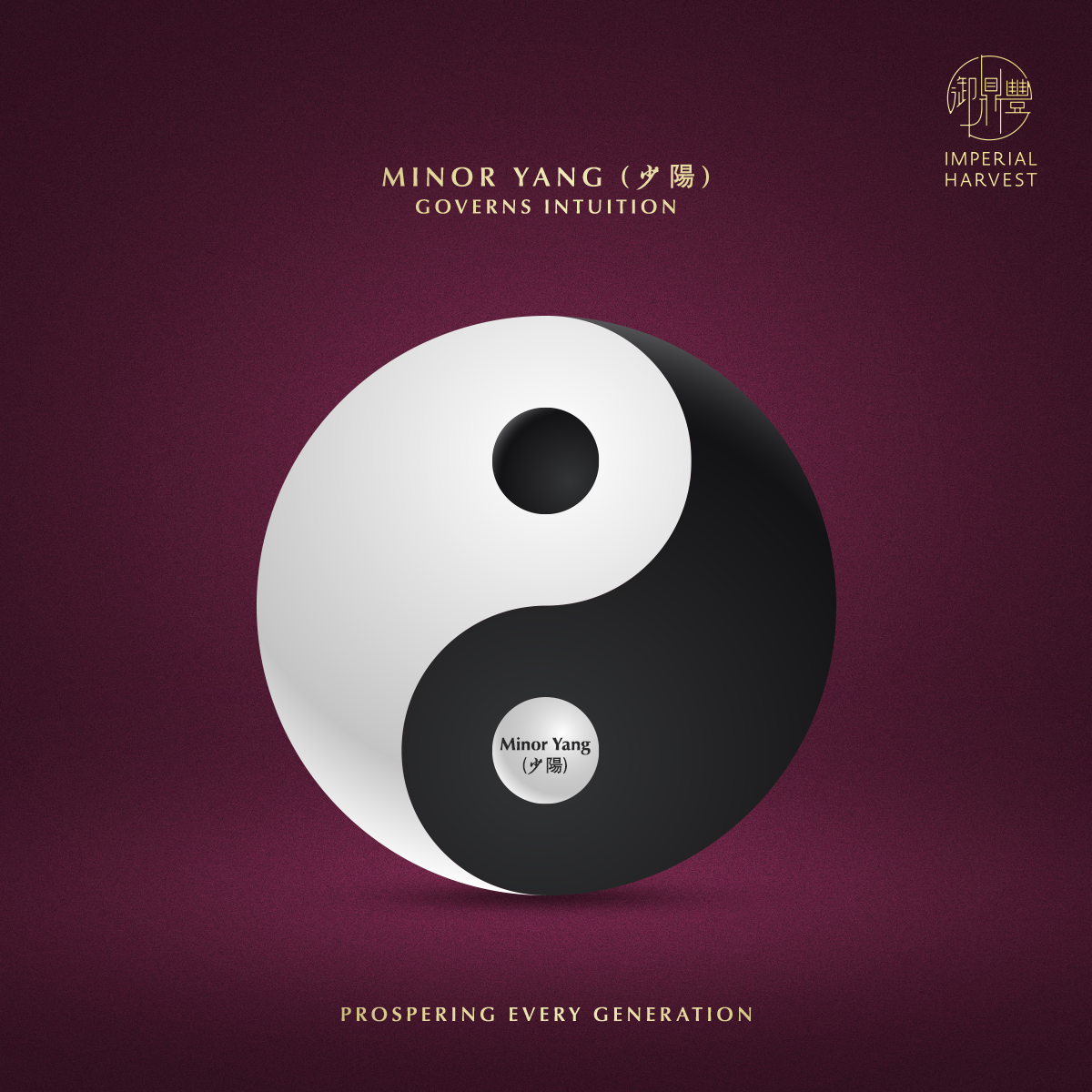
Minor Yang (少陽) governs Intuition and give first move advantage — the precision of judgment under pressure, and the capacity to act decisively in moments where the right decision window is narrow. When Minor Yang is aligned, the person reads situations accurately and converts clarity into action without hesitation. When Minor Yang is constrained, the person hesitates at exactly the moments that matter, second-guesses correct judgments, and watches opportunities pass while analysis substitutes for movement.
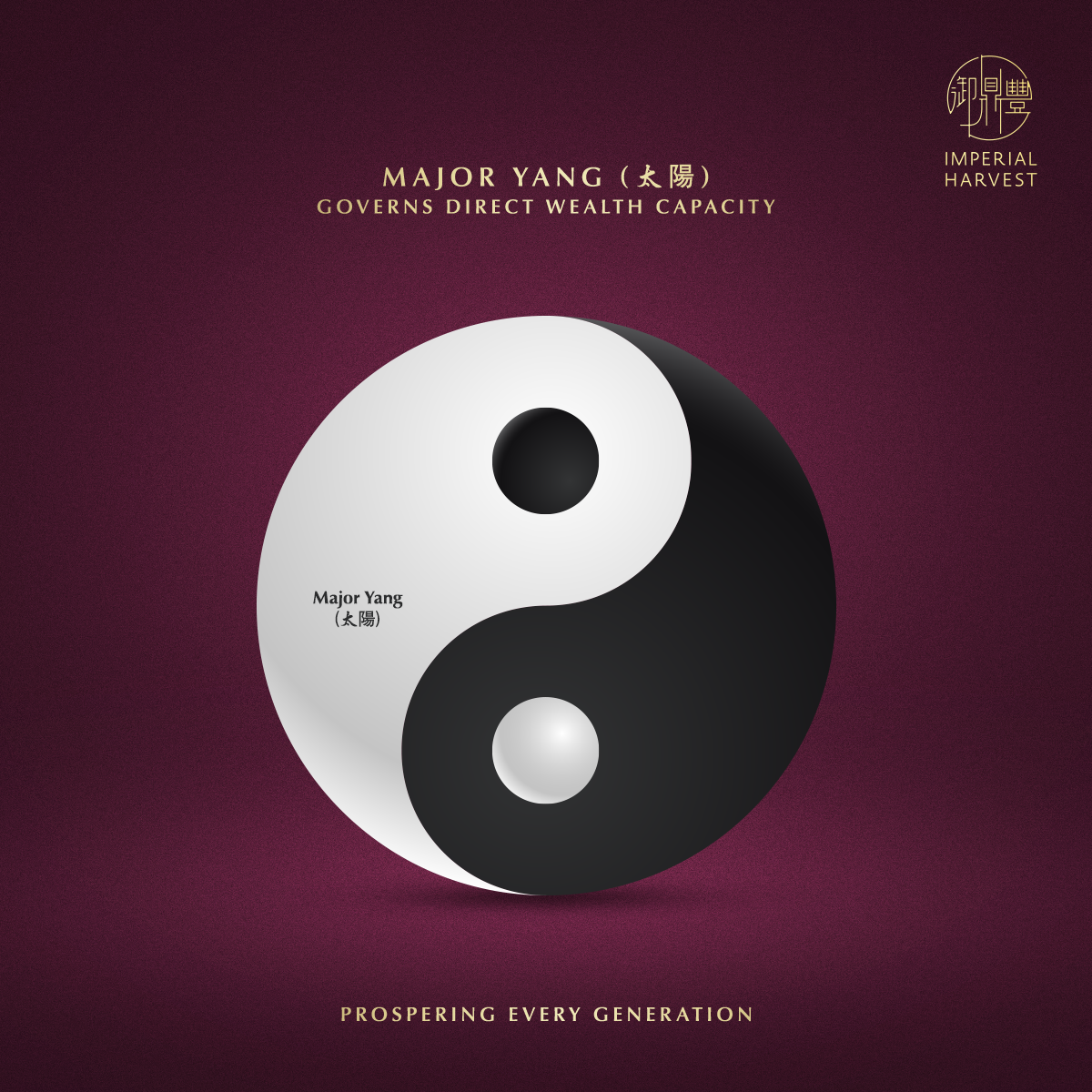
Major Yang (太陽) governs Direct Wealth Capacity — 正財庫 — the structural ceiling on the wealth a person’s direct effort can produce. This is the force that determines whether income compounds through promotion, sales performance, or business growth — or whether income plateaus at a specific level regardless of how hard the person pushes. Major Yang is the most felt of the four quadrants, because it is the one that most directly manifests as the income ceiling the person has been pressing against for years.
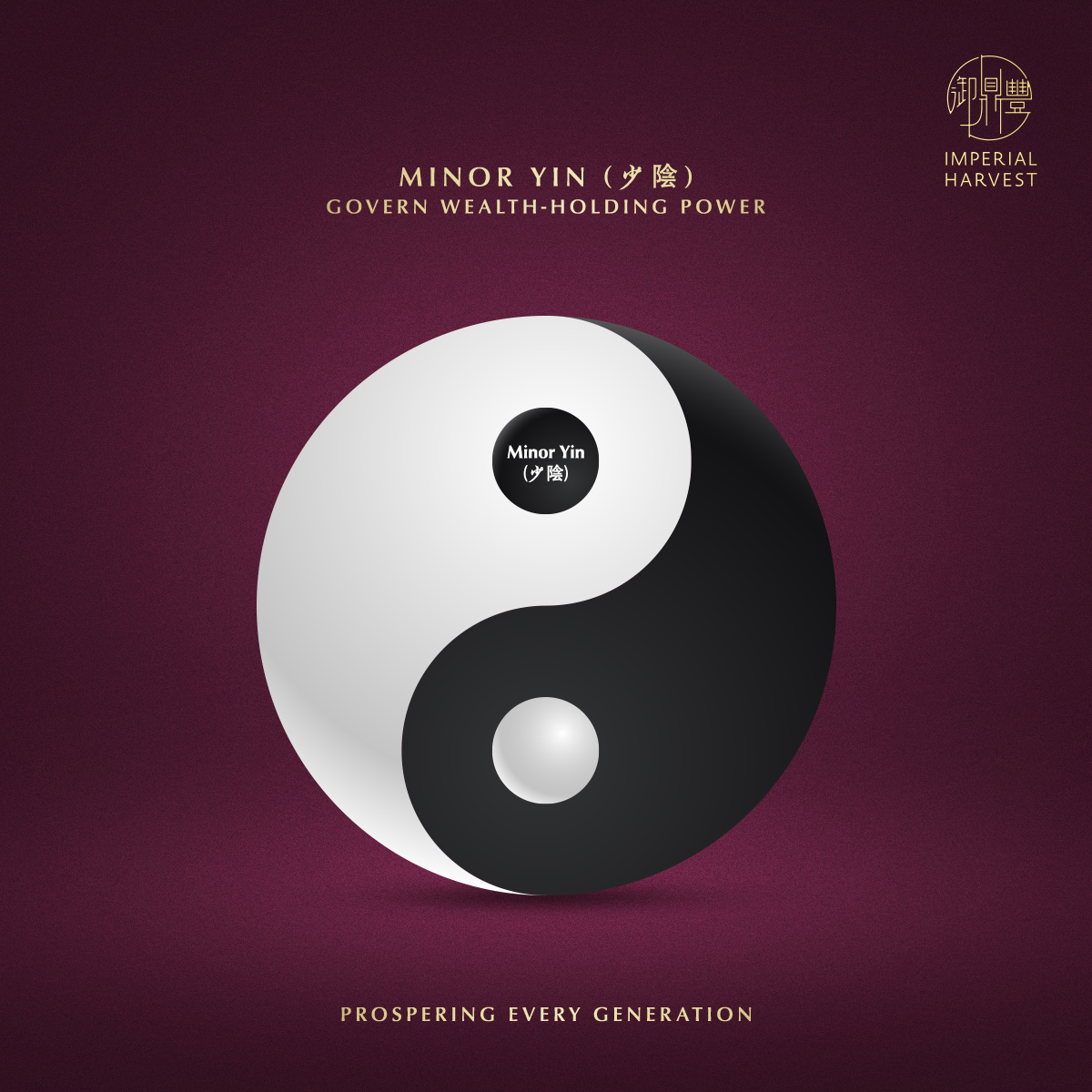
Minor Yin (少陰) governs Indirect Wealth Capacity — 偏財庫 — the structural ceiling on wealth generated through leverage rather than direct effort. Investments, trading, property appreciation, partnerships, and passive income. When Minor Yin is aligned, leverage works for the person — capital compounds, positions appreciate, and the wealth produced through ownership begins to exceed the wealth produced through labour. When Minor Yin is constrained, the person’s financial life remains entirely dependent on active effort, regardless of how much they earn.
These four forces are the structural diagnostic the Bazi reading is organised to produce. A first-class reading identifies which quadrants are aligned and which are constrained, the specific severity of each constraint, and — critically — the sequence in which the constraints should be addressed. The fuller exposition of this framework, including named client examples of each quadrant in operation, is the subject of the next essay in this series.
Why the reading happens in classical Chinese
A small but consequential detail of Grand Master David Goh’s practice: he reads every client’s chart personally, and he reads it in the classical Chinese in which the system was articulated and is able to explain the complex and difficult to understand concepts in understandable, relatable ways in modern language. He does not work through English-language interpretations or translations. He does not consult software. The chart, the luck pillars, the annual shifts, and the commentaries that govern their interpretation are engaged in their original language, because the structural meanings the system encodes cannot be faithfully expressed in any other.
This is not a preference. Bazi was developed inside the Chinese language, and its core concepts — 用神, 忌神, 格局, 大運, 藏干 — have no single-word English equivalents because they refer to structural relationships that English does not have the metaphysical vocabulary to express. A practitioner who reads Bazi only in English translation is working through a filter that drops most of what the system was built to communicate. The readings such a practitioner produces can be accurate at the level of individual statements, but they cannot reach the structural synthesis that the classical language makes possible.
This is part of what separates a first-class practice from every tier beneath it. The language of the reading determines what the reading can see. The language of Imperial Harvest’s reading is the language the system itself was written in.
Book A Free ConsultationWhat the client receives

A complimentary Bazi consultation with Grand Master David Goh is the entry point to the Imperial Harvest practice. It is conducted personally, in a private setting at the Delfi Orchard gallery, without obligation and without sales pressure. The client provides their exact date, time, and place of birth. Grand Master David Goh casts the chart, reads it in classical Chinese, able to explain in modern language and produces a structural diagnosis organised through the Four Quadrants framework. By the end of the consultation, the client has seen — often for the first time — a coherent structural explanation for outcomes in their career, wealth, and relationships that they have previously been unable to explain through effort or strategy alone.

The diagnosis is, in itself, valuable. Many clients describe the first consultation as the first time they have received an account of their own trajectory that makes structural sense — not a horoscope, not a forecast, but a map of the forces that have been operating beneath outcomes they had attributed to luck, timing, or personal limitation. For some clients, the diagnosis alone is the insight they came for. For others, it is the foundation for the stewardship that follows — the sequenced activation, through consecrated Imperial treasures, of the quadrants the diagnosis has identified as constrained.
Either way, the reading itself is not the end of the conversation. It is the beginning of it. A Bazi chart read at the first-class tier does not conclude with advice. It concludes with a map — and an invitation to consider what can be done about what the map reveals.
Part One · The Imperial Court Tradition Singapore Kept
Part Two · What Imperial Destiny Engineering Protocol (御用移星換斗法) Actually Means
Part Three · Bazi, Read as Classical Chinese
Part Four · The Four Quadrants of Destiny
Part Five · The Ceremonial Anchor
Part Six · The Stewardship Cycle